Table of Contents
- Introduction
- How YouTube Shorts Pays Creators
- How TikTok Creator Rewards Pays Creators
- The Eligibility Gap Between the Two
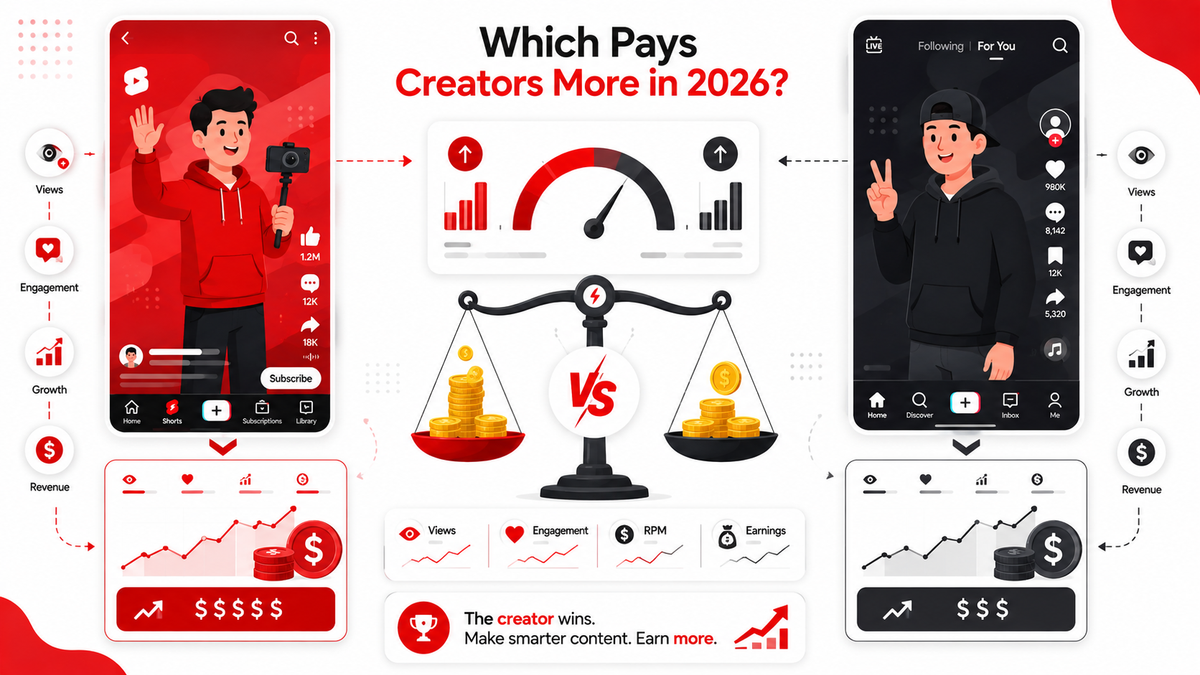
- Side-by-Side: Shorts vs TikTok
- Per 1,000 Views: An Honest Comparison
- Which Platform Pays More per View?
- Which Is More Reliable Long Term?
- Why Repurposing Across Both Wins
- How to Use the Thumbix Shorts Earnings Calculator
- Frequently Asked Questions
- Final Takeaway
TikTok's Creator Rewards rate looks better on paper, but Shorts pays on every monetized video with far looser eligibility. Here's the honest per-1,000-view comparison for 2026.
Pick your corner of the internet and someone is arguing about which platform pays better: YouTube Shorts or TikTok. The confident answers are almost always wrong, because the two programs measure money differently, gate it differently, and even define what counts as a paid view differently. The honest 2026 comparison is that TikTok's Creator Rewards Program quotes a higher headline rate per 1,000 views, but it applies only to qualified views on videos over one minute long in a handful of markets, while YouTube Shorts pays a much smaller per-view rate on every eligible Short with no length gate. This guide lays out both models side by side and tells you which one to build your income on.
Introduction
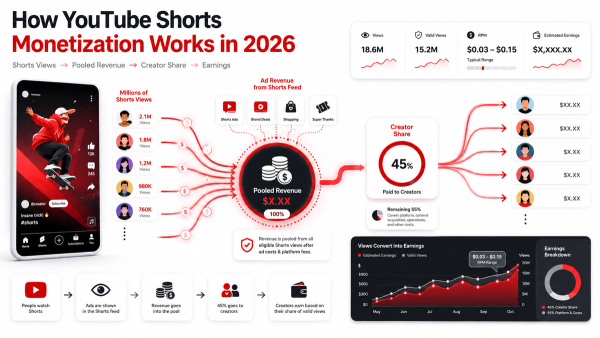
Before you can compare the money, you have to compare the mechanics. YouTube Shorts monetization runs on a pooled-revenue model: ads in the Shorts feed fund a global pool, music licensing is deducted, creators receive a share based on their eligible views, and they keep 45% of that allocation. TikTok Creator Rewards pays creators a rate per 1,000 qualified views on videos longer than one minute, with a headline range around $0.40 to $1.00 per 1,000 qualified views, but only for creators who clear steep eligibility gates and only in select markets. That contrast drives everything in this article. TikTok's rate looks like a multiple of Shorts' typical $0.03 to $0.15 per 1,000 views, yet most short-form creators earn more total money from YouTube over time, because Shorts monetizes nearly everything you post while TikTok only pays a fraction of your output. The two platforms are not measuring the same thing, and this guide untangles all of it.
How YouTube Shorts Pays Creators
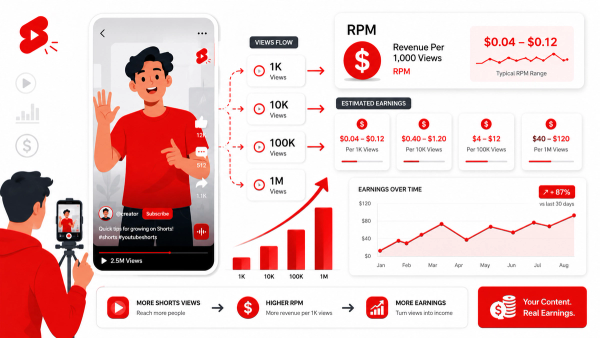
Shorts monetization in 2026 has four features you need to compare honestly. First, it is pooled. Ads run between Shorts in the Shorts feed, the revenue is pooled, music licensing costs are deducted, and each creator is allocated a share based on their eligible views. Second, the creator share is 45% of that allocation. Third, there is no length gate for payment: Shorts can be up to 60 seconds in 2026, and every eligible Short monetizes whether it is 15 seconds or 59 seconds. Fourth, there is no follower threshold inside the payment mechanic itself, only the Partner Program entry requirements, which include either the long-form watch-hour path or the 10 million Shorts views in 90 days path. Typical Shorts RPM runs $0.03 to $0.15 per 1,000 views, with $0.04 to $0.10 most common, and per million Shorts views most creators earn roughly $50 to $150. Those are estimates, and they are small, but they apply to virtually everything you publish that qualifies. If you want the full mechanics of the pool, our How YouTube Shorts Monetization Works guide walks through it step by step.
How TikTok Creator Rewards Pays Creators
TikTok's Creator Rewards Program is a different animal. It pays a rate per 1,000 qualified views on videos that are longer than one minute. The headline rate for 2026 is roughly $0.40 to $1.00 per 1,000 qualified views, which sounds dramatically better than Shorts. The fine print is where the comparison lives:
- Videos must be over one minute long. Most of TikTok's own viral format, sub-30-second clips, earns nothing at all under Creator Rewards.
- Views must be qualified. TikTok excludes certain views from payment, including views from some regions, low-quality or recycled content, and views that do not meet engagement thresholds.
- Eligibility is steep: 10,000 followers, 100,000 video views in the last 30 days, an account age of at least 30 days, and being 18 or older.
- Availability is limited. Creator Rewards is offered in a select set of markets, including the US, UK, Germany, France, Japan, Brazil, and Korea, and creators outside those markets cannot access the program at all.
So the high TikTok rate is real but narrow: it applies to a fraction of creators, in a fraction of countries, on a fraction of their videos. For most TikTok creators, the effective earning rate across all their content is far lower than the headline number suggests.
The Eligibility Gap Between the Two
This is the part most comparisons skip. Getting paid on TikTok requires 10,000 followers, 100,000 views in the last 30 days, an 18-plus age minimum, and residency in an eligible market. Getting paid on YouTube Shorts requires being in the Partner Program, which in 2026 means 1,000 subscribers plus either 4,000 watch hours or 10 million Shorts views in 90 days, and monetizing everything original you post once you are in. Two gaps matter practically. First, the follower gap: 1,000 subscribers on YouTube is a much lower bar than 10,000 followers on TikTok, especially since Shorts viewers convert to subscribers readily. Second, the geography gap: Creator Rewards simply does not exist for creators outside its select markets, while Shorts monetization is open to every market where the Partner Program operates. A creator in, say, an emerging market can monetize Shorts but has no TikTok Creator Rewards access at all. For anyone outside the seven or so TikTok markets, the comparison is not a comparison.
Side-by-Side: Shorts vs TikTok
The table below stacks the two programs in 2026. All figures are estimates and current rules are summarized.
- Typical payout per 1,000 views: $0.03-$0.15, $0.40-$1.00
- What counts: Eligible Shorts views, Qualified views only
- Minimum video length: None (Shorts up to 60s), Over 1 minute
- Follower threshold: 1,000 subs (YPP entry), 10,000 followers
- Recent views threshold: 10M Shorts views/90 days (or 4K watch hrs), 100,000 views in 30 days
- Age requirement: Partner Program age rules, 18 or older
- Markets: Wherever YPP operates, Select markets only
- Creator share: 45% of pool allocation, Varies by rate
- Pays on: Every eligible Short, Only videos over 1 min
- Est. per 1M eligible views: $50-$150, $400-$1,000 (qualified)
Read the last row carefully. The TikTok figure applies only to qualified views on videos longer than a minute. If a creator's eligible-for-payment fraction is 20% of their total views, the real-world rate across all views drops to roughly $0.08 to $0.20 per 1,000 total views, which is suddenly in the same neighborhood as Shorts. The headline rate is only part of the story.
Per 1,000 Views: An Honest Comparison
The honest comparison has to normalize for what each program actually pays on. Let us do the math on a million total short-form views. On YouTube, assume a typical Shorts RPM of $0.08, and assume most Shorts are eligible because they are original. A million Shorts views yields roughly $80 in estimated revenue. At the low end of $0.04, it is $40; at the high end of $0.15, it is $150. On TikTok, assume the rate is $0.60 per 1,000 qualified views and that qualified views are about 20 to 25% of total views for a typical creator, because of the one-minute minimum and view-exclusion rules. A million total TikTok views yields roughly 200,000 to 250,000 qualified views, which is $120 to $150. At a $0.40 rate with a 20% qualification rate, it is closer to $80. So a creator who monetizes everything on both platforms may actually end up in a similar range per million total views, with TikTok's advantage shrinking as the qualification rate drops. The TikTok number looks like a multiple because it quotes a rate for a much narrower slice of views. If you want to model your own scenarios instead of reading averages, the Thumbix Shorts Earnings Calculator handles the YouTube side precisely.
Which Platform Pays More per View?
If the question is strictly per 1,000 qualified views on videos over a minute, TikTok wins on headline rate. That is not a controversial statement; it is how the program is designed. If the question is which platform pays more across everything you actually publish, the answer depends on your format and your audience, and for most creators the edge is far smaller than the marketing suggests. For very short clips under a minute, YouTube Shorts wins by default, because TikTok does not pay on them at all. For creators outside TikTok's eligible markets, YouTube Shorts wins by default, because there is no alternative. For longer vertical content with a US or UK audience where the creator meets the follower threshold, TikTok's per-view rate is genuinely higher, and that is where creators who prioritize it see better direct short-form income. The practical takeaway: the higher TikTok rate is real, but it is conditional on a long list of requirements that exclude most short-form creators.
Which Is More Reliable Long Term?
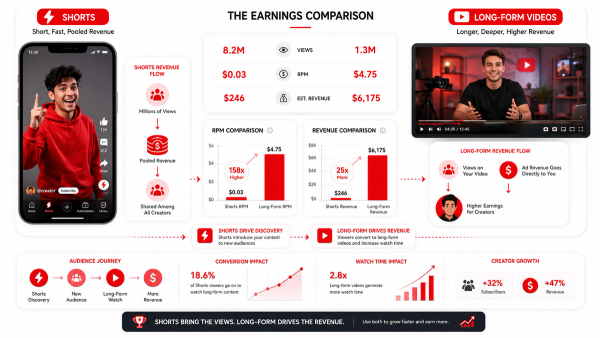
Reliability is where YouTube pulls decisively ahead, and it is why most professionals treat YouTube as the primary asset. Shorts views accumulate toward a 1,000-subscriber base and a permanent audience, and those subscribers convert to long-form viewers, memberships, fan funding, and brand deals. Revenue keeps flowing to every eligible Short, regardless of length, country, or whether the video hit a trending window. YouTube's program is open across the markets where the Partner Program operates, and the pooled model, while low per view, is dependable across all your output. TikTok pays on a narrower slice, requires 10,000 followers before the program even matters, excludes markets, and pays only on videos over a minute with qualified views. A TikTok audience also lives inside a feed that favors trend-chasing, which makes it a weaker long-term asset for building an owned, monetizable audience. TikTok works best as a discovery surface that routes viewers to a channel you control, and the YouTube Shorts vs Long-Form guide explains why that owned-audience structure is the durable part of the income stack.
Why Repurposing Across Both Wins
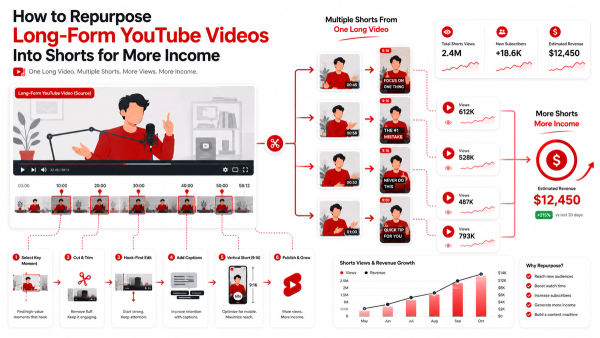
The best answer to a false either-or is to use both, with a clear division of labor. Make YouTube Shorts the primary short-form asset because of its reliability, monetization openness, and subscriber compounding. Use TikTok as a discovery engine that reaches audiences YouTube does not, and keep its earnings as a bonus rather than a plan. Repurposing the same original content to both platforms costs almost nothing, and it doubles your surface area for the same production effort. Our repurpose YouTube videos into Shorts guide covers the workflow of turning one long-form video into a batch of Shorts, and the same batch can be trimmed for TikTok with platform-specific hooks. Keep the originals on YouTube, post the derivatives everywhere, and let each platform feed the funnel back to your owned channel. That structure survives format changes, payout changes, and policy changes on either platform, which is the only reliable strategy in 2026.
How to Use the Thumbix Shorts Earnings Calculator
To make this comparison personal, start with the Thumbix Shorts Earnings Calculator. Enter your Shorts views and a realistic RPM from the $0.03 to $0.15 range, and the calculator returns estimated YouTube earnings. Compare that with your own TikTok qualified views to see, with your real numbers, whether the platform gap matters for your audience. Add the Thumbix YouTube Money Calculator to fold in long-form and estimate total channel income, which is the number that actually decides which platform you build on. Both tools are free, transparent, and based on the same estimates used throughout this article, so the outputs stay comparable and honest.
Final Takeaway
TikTok's Creator Rewards pays a higher headline rate of roughly $0.40 to $1.00 per 1,000 qualified views, but it requires 10,000 followers, 100,000 recent views, an 18-plus age, videos over one minute, and residency in a select market. YouTube Shorts pays a typical $0.03 to $0.15 per 1,000 views on every eligible Short, with no length gate and no follower requirement beyond Partner Program entry. Once you account for the TikTok gates, the real-world difference per million total views narrows dramatically. Build YouTube Shorts as your primary monetized asset, use TikTok for discovery, repurpose everything, and model the money with the Thumbix Shorts Earnings Calculator before you choose sides.
Frequently Asked Questions
Does YouTube Shorts or TikTok pay more in 2026?
TikTok's headline rate of $0.40-$1.00 per 1,000 qualified views is higher than Shorts' typical $0.03-$0.15, but TikTok only pays on qualified views of videos over a minute in select markets. After those gates, the real-world difference per million total views narrows sharply.
How much does TikTok pay per 1,000 views in 2026?
The Creator Rewards Program pays roughly $0.40 to $1.00 per 1,000 qualified views, but only on videos over one minute, for creators with 10,000 followers and 100,000 views in 30 days, in select markets. These are estimates.
Can I make money on YouTube Shorts without 10,000 subscribers?
Yes. Shorts monetization requires Partner Program entry, which in 2026 means 1,000 subscribers plus either 4,000 watch hours or 10 million Shorts views in 90 days. That is a much lower follower bar than TikTok's 10,000.
Why does TikTok pay more per view than YouTube Shorts?
TikTok quotes a rate for qualified views on videos longer than a minute, which is a narrow, engagement-filtered slice. YouTube Shorts pays a pooled 45% share on every eligible Short, which spreads the revenue thinner but across far more of your output.
Is TikTok Creator Rewards available in my country?
Only in select markets including the US, UK, Germany, France, Japan, Brazil, and Korea. Creators outside those markets cannot access Creator Rewards, while Shorts monetization operates wherever the Partner Program does.
Should I post the same videos to Shorts and TikTok?
Yes. Repurpose original content to both platforms: keep the originals on YouTube for reliability and subscriber growth, and use TikTok as a discovery engine. Post derivatives everywhere and route the audience back to your owned channel.
Which platform is more reliable for creator income?
YouTube. Shorts monetizes every eligible video, has no per-video length gate, operates across more markets, and builds an owned audience that converts to long-form, memberships, and brand deals. TikTok's program is narrower and more conditional.