Table of Contents
- Introduction
- What Is Shorts RPM?
- Shorts RPM vs Long-Form RPM
- Why Is Shorts RPM So Much Lower?
- Realistic Shorts RPM Ranges in 2026
- What Raises Your Shorts RPM
- Shorts Earnings at Different RPMs
- How to Find Your Actual Shorts RPM in Studio
- How Shorts Feed Long-Form Earnings
- How to Use the Thumbix Shorts Earnings Calculator
- Frequently Asked Questions
- Final Takeaway
Shorts RPM in 2026 runs $0.03-$0.15 per 1,000 views — far below long-form. This guide explains why, what raises it, how to find your real number in Studio, and what earnings to expect.
Ask five creators what Shorts pay per 1,000 views and you will hear five different answers, most of them wrong in the same direction. Some claim Shorts pay almost nothing; others quote numbers they saw on a thumbnail. The honest 2026 answer is that typical Shorts RPM runs between $0.03 and $0.15 per 1,000 views, with $0.04 to $0.10 being the most common band and US audiences sitting at the top end. That is a real range, not a rumor, and this article explains exactly where it comes from, why it is so much lower than long-form, what actually raises it, and how to find the number for your own channel.
Introduction
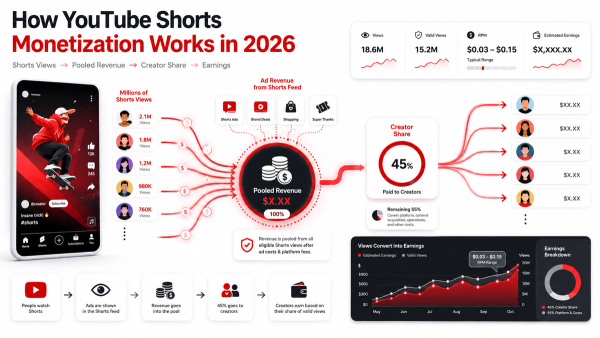
RPM stands for revenue per mille, or revenue per 1,000 views, and it is the single most useful number on your YouTube dashboard because it tells you what you actually keep. For Shorts, RPM is the per-1,000-views figure that comes out of the pooled revenue model: ads in the Shorts feed fund a global pool, music licensing is deducted, your eligible views determine your share, and you keep 45% of that allocation. The Shorts RPM you see in Studio already has all of that baked in. Across 2026, most creators land between $0.03 and $0.15 per 1,000 Shorts views. Per million views, that is roughly $50 to $150 for typical channels. Those are estimates that vary by audience country, niche, retention, and month, but they are the numbers to plan around, and this guide shows you how to measure your own rather than guess.
What Is Shorts RPM?
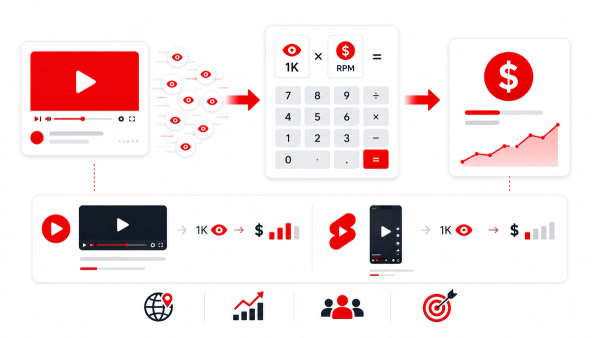
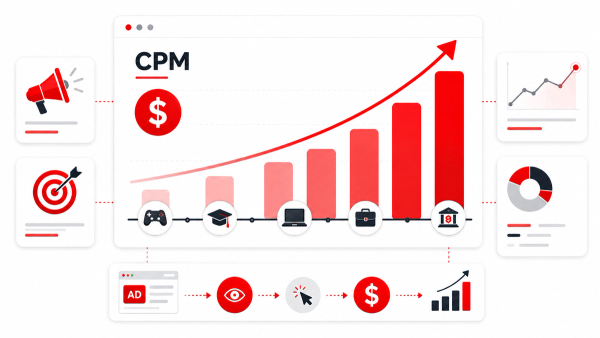
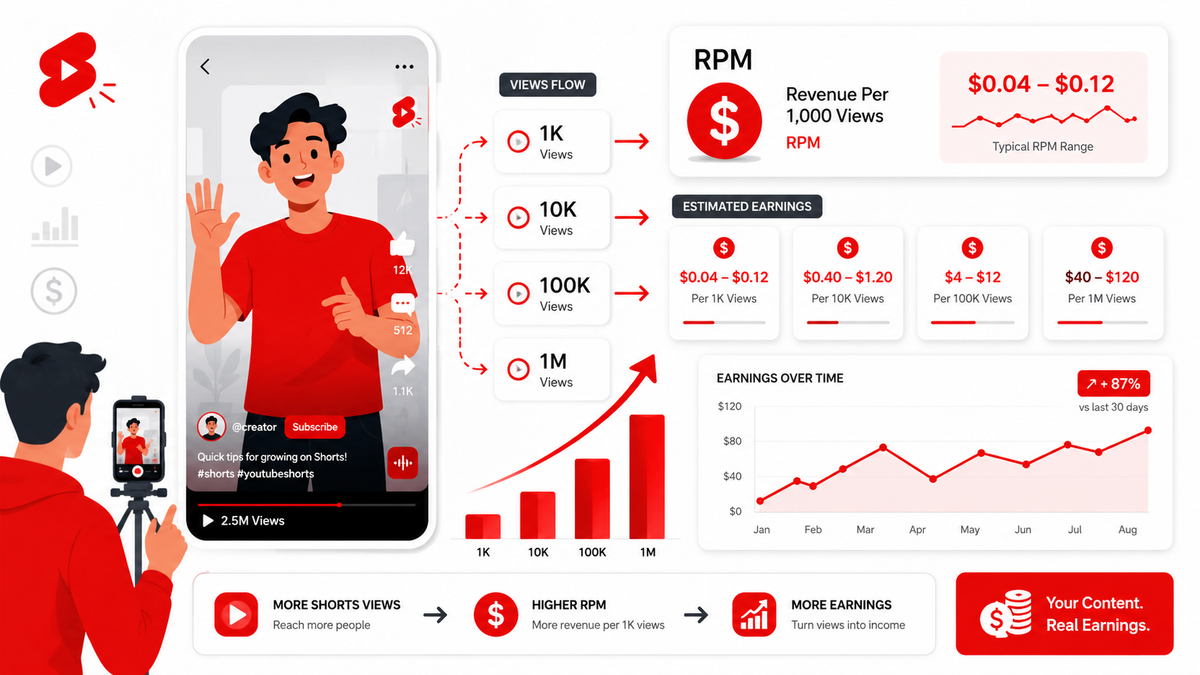
RPM is the revenue you keep per 1,000 monetized views, and for Shorts it is reported separately from long-form RPM in YouTube Studio because the two formats earn completely differently. A long-form RPM is built from the ads that played on your video. A Shorts RPM is built from your share of the Shorts revenue pool, which depends on how many of your views counted as eligible. A useful way to think about it: Shorts RPM is the number you multiply by thousands of views to get estimated revenue. Ten thousand views at a $0.08 RPM is $0.80. A hundred thousand views at $0.08 RPM is $8. A million views at $0.08 RPM is $80. The math is not complicated; the rate is just small, and the smallness of the rate is the entire story of Shorts monetization. It also matters that Shorts RPM is not the same as Shorts CPM. CPM describes what advertisers pay for 1,000 impressions in the feed; RPM is what you keep per 1,000 views after revenue share and deductions. The gap between the two is wider for Shorts than for any other format, because music licensing and the pool mechanics sit in between.
Shorts RPM vs Long-Form RPM
Long-form RPM is dramatically higher, and the gap is the single biggest misconception in short-form content. A reasonable 2026 frame of reference:
- Median long-form RPM across all creators: roughly $2.30 per 1,000 views
- Finance and business channels: often $8 to $20 or more
- Education content: commonly around $10
- Gaming and entertainment: typically $2 to $5
- Shorts RPM: typically $0.03 to $0.15, with $0.04 to $0.10 most common
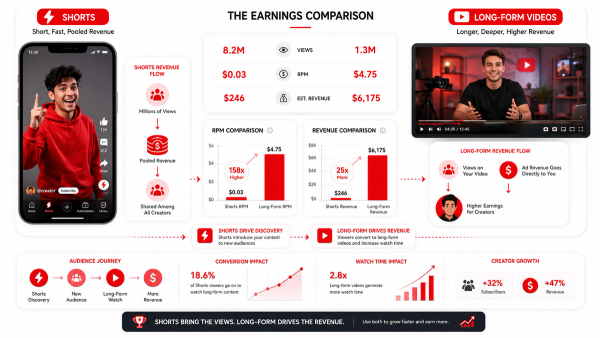
That means long-form can pay roughly 15 to 50 times more per 1,000 views than Shorts, depending on the niche. A finance long-form video at a $15 RPM earns $150 per 10,000 views, while a Short at a $0.08 RPM earns $0.80 for the same view count. The comparison is stark, and it is exactly why successful channels rarely rely on Shorts revenue alone. Our YouTube RPM Explained guide covers the long-form side in detail if you want the full picture.
Why Is Shorts RPM So Much Lower?
Four structural reasons push Shorts RPM below long-form, and none of them are going to change in 2026. First, there is no ad inside the video. Long-form videos can carry pre-roll, mid-roll, and post-roll ads, sometimes several per video, each earning its own auction. Shorts have no in-video ads at all; monetization happens between Shorts in the feed. Second, the pooled model averages everyone together. Your long-form revenue reflects what advertisers pay for your specific audience in your specific niche. Shorts revenue reflects your share of a global pool, which washes out the niche premium you might otherwise earn. Third, music licensing is deducted before creators are paid. Shorts run on licensed audio, and those costs come out of the pool, shrinking what is left for creators. Fourth, the creator share is lower. Long-form splits 55/45 in the creator's favor. Shorts pays creators 45% of their allocation. Combined with the licensing deductions and the averaging effect of the pool, a low RPM is the expected outcome, not a bug.
Realistic Shorts RPM Ranges in 2026
Working ranges make the number practical. In 2026, here is how Shorts RPM distributes in practice:
- Low end: $0.02 to $0.04, common for audiences concentrated in developing markets or highly competitive niches with low advertiser demand
- Most common: $0.04 to $0.10, where the majority of monetized channels sit
- High end: $0.10 to $0.15, typical for US and UK-heavy audiences, finance-adjacent or tech audiences, and channels with strong watch-through
- Occasional spikes: above $0.15 in high-demand months such as the fourth quarter, especially for advertiser-friendly niches
These are estimates, and your own Shorts RPM will bounce around month to month. What you should not do is average the internet's claims and build expectations on them. The realistic planning number for a new channel is around $0.05 to $0.08 per 1,000 Shorts views, and anything above $0.10 is genuinely good. Our What Is a Good YouTube CPM? article explains the advertiser side of this number. Seasonality also moves the range. The fourth quarter, when advertisers pay the most across the platform, is routinely the best month for Shorts RPM, and the first quarter is often the softest. A channel can see its Shorts RPM swing by 20 to 40% between those two periods without changing a single upload, which is why comparing your number against the same quarter last year is more honest than comparing it against last month. If your Shorts RPM dips in January, that is the market, not a signal that your content suddenly got worse, and it is worth remembering before you overreact and change a strategy that is actually working. A final reality check: Shorts RPM is reported on a delay, because the pool takes time to settle. The number Studio shows you today for last week is still an estimate that will keep adjusting, sometimes for weeks. That lag is normal, it affects every channel, and it is the reason any single-day RPM reading is essentially meaningless. Always evaluate your Shorts RPM over a 28-day or 90-day window and only after a settlement buffer, so the trend you are reading is real.
What Raises Your Shorts RPM
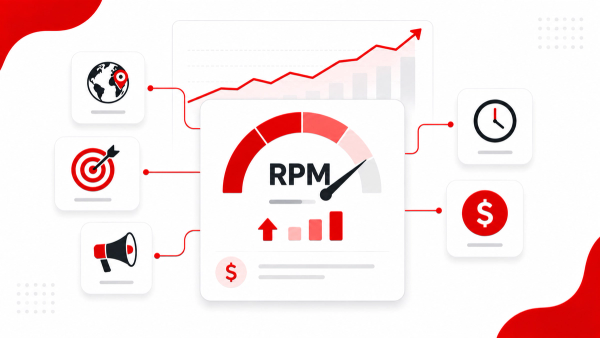
You cannot control the pool, but you can control several variables that push your share of it up. The levers that matter most:
- Audience geography. Viewers in the US, UK, Canada, and Australia make your views more valuable to the pool's allocation math than viewers in lower-CPM markets. Content that naturally travels to wealthy English-speaking audiences tends to post higher Shorts RPM.
- Watch-through rate. Shorts that people watch to the end, rather than swipe away in the first two seconds, are weighted more heavily in how the pool values views. Longer average view duration within the 60-second limit helps.
- Niche and advertiser friendliness. Finance, tech, education, and other advertiser-friendly categories typically land higher in the pool's allocation than edgy or hard-to-monetize niches.
- Originality and eligibility. Every ineligible view is a view that earns nothing. Keeping every Short original keeps every view in the math.
- Consistency. A channel with steady daily uploads builds a more reliable eligible-views history than a channel that uploads a burst every few weeks.
None of these turn a $0.05 RPM into a $1 RPM. They move the number within the realistic envelope, and over millions of views the difference between $0.05 and $0.12 is real money.
Shorts Earnings at Different RPMs
The table below shows estimated monthly earnings for different view counts at different Shorts RPMs. Pick your likely RPM, find your view count, and you have a planning number. All figures are estimates and will vary.
- 50,000: $2, $4, $6
- 200,000: $8, $16, $24
- 500,000: $20, $40, $60
- 1,000,000: $40, $80, $120
- 5,000,000: $200, $400, $600
- 10,000,000: $400, $800, $1,200
Two reads of this table are worth keeping. First, Shorts revenue scales linearly, so volume is the main lever at a fixed RPM. Second, the same view count at the top of the RPM range is worth three times what it is at the bottom, which is why geography and retention matter even though they move a small number. If you want to see your exact combination, the Thumbix Shorts Earnings Calculator does the multiplication for you.
How to Find Your Actual Shorts RPM in Studio
Your real Shorts RPM is already sitting in YouTube Studio, and finding it takes under a minute. Open YouTube Studio and go to Analytics, then select the Revenue tab. Look for the Shorts RPM figure, which is shown separately from long-form RPM. Switch the date range to the last 28 days or the last 90 days, because a single day of Shorts revenue is too small and too noisy to mean anything. The number Studio shows is estimated revenue per 1,000 Shorts views with your 45% share already applied. Two caveats before you trust the number. First, Shorts revenue estimates keep adjusting for weeks after the fact as the pool and view validation settle, so a fresh Short can look overpaid or underpaid at first. Second, if you have both Shorts and long-form revenue, make sure you are reading the Shorts-specific figure and not the blended RPM. To confirm the math, divide the Shorts revenue estimate by thousands of Shorts views; if the result matches the Studio RPM, you are reading the right number.
How Shorts Feed Long-Form Earnings
The most important thing to understand about Shorts RPM is that the direct payout is not the main payout. A Short at a $0.08 RPM earns $0.08 per 1,000 views, but a single viral Short can send thousands of viewers to your long-form videos, which earn at a 15-to-50-times higher rate. Channels report Shorts as the discovery engine and long-form as the money engine, and the loop is the standard playbook for 2026. So when someone says Shorts do not pay, the accurate version is that Shorts do not pay much directly, but they routinely change which long-form videos get watched. Measure a Short by the long-form watch time it creates, not only by its RPM, and the economics look very different. Our Shorts vs long-form comparison and how much YouTube pays per 1,000 views guides both dig into this loop. There is also a non-financial multiplier worth naming. Every Short view is a chance to convert a scroller into a subscriber, and subscribers compound: they watch long-form, they enable fan funding once a channel qualifies, and they make brand deals possible long before AdSense balances look impressive. A Short with a $0.08 RPM and 1 million views earns about $80 in estimated direct revenue, but if that same Short adds a few thousand subscribers who watch long-form at a $5 RPM, its real contribution can be orders of magnitude larger. That is the honest way to value short-form content in 2026, and it is why this guide keeps returning to the same conclusion: the RPM is small, the asset is not.
How to Use the Thumbix Shorts Earnings Calculator
The Thumbix Shorts Earnings Calculator turns this whole article into a personal number. Enter your Shorts views, pick an RPM from the realistic range, and the calculator shows estimated revenue. Flip it around: enter a revenue goal and it shows the views required at that RPM, which is the planning view most creators actually need. Use the Thumbix RPM Calculator to back out your measured RPM from revenue and views you already have, and the Thumbix YouTube Money Calculator to blend Shorts and long-form estimates into a total channel picture. All three are free, they use the same transparent estimates, and they make it easy to stress-test scenarios from this article, like a $0.05 RPM versus a $0.12 RPM on the same view count.
Final Takeaway
Shorts RPM in 2026 is typically $0.03 to $0.15 per 1,000 views, with $0.04 to $0.10 the most common band, because Shorts split a global revenue pool after music licensing and pay creators 45% of their allocation. Long-form pays 15 to 50 times more per view, so treat Shorts as a discovery engine and measure them by the long-form watch time they create. Find your real Shorts RPM in Studio under Analytics and Revenue, and use the Thumbix Shorts Earnings Calculator to plan around numbers you can verify instead of averages you cannot.
Frequently Asked Questions
What is YouTube Shorts RPM?
Shorts RPM is revenue per 1,000 Shorts views, calculated from your share of the Shorts revenue pool with your 45% cut already applied. It is reported separately from long-form RPM in Studio.
How much do YouTube Shorts pay per 1,000 views in 2026?
Typically $0.03 to $0.15, with $0.04 to $0.10 the most common range. US and UK-heavy audiences sit at the top end. These are estimates that vary by audience and month.
Why is Shorts RPM so much lower than long-form RPM?
Shorts have no in-video ads, revenue is averaged across a global pool, music licensing is deducted first, and creators keep 45% instead of the 55% long-form pays. All four factors push the rate down.
How do I find my Shorts RPM in YouTube Studio?
Open Studio, go to Analytics, open the Revenue tab, and read the Shorts RPM figure. Use a 28- or 90-day range, because single days are too noisy, and remember the estimate keeps adjusting for weeks.
What raises Shorts RPM?
Audiences in high-CPM countries, strong watch-through, advertiser-friendly niches, fully eligible original content, and consistent uploads all push your RPM up within the realistic $0.03-$0.15 envelope.
How much can I earn from 1 million Shorts views?
At a typical $0.04 to $0.10 RPM, roughly $40 to $100 per million Shorts views. At the $0.15 high end, around $150. These are estimates, and the real value usually comes from Shorts driving long-form views.
Is Shorts RPM the same as Shorts CPM?
No. CPM is what advertisers pay per 1,000 impressions. RPM is what you keep per 1,000 views after revenue share, licensing, and pool mechanics. For Shorts the gap is larger than for any other format.