Table of Contents
- Introduction
- What Is YouTube RPM?
- The YouTube RPM Formula
- RPM vs CPM: What's the Difference?
- Why RPM Is More Important for Creators
- What Is a Good YouTube RPM?
- Average RPM by YouTube Niche
- Average RPM by Country
- Why Your RPM Changes
- How Seasonality Affects RPM
- How Video Length Can Affect RPM
- How Audience Demographics Affect RPM
- 10 Ways to Increase Your YouTube RPM
- Use the Thumbix RPM Calculator
- RPM Examples With Realistic Calculations
- Frequently Asked Questions
- Conclusion
RPM is the one number that tells you what your channel really earns per 1,000 views. Here's how it's calculated, why it moves, and 10 ways to push it higher.
Introduction
Ask ten creators what their videos earn and you'll get ten different numbers — and most of them won't be comparing the same thing. RPM fixes that. RPM stands for revenue per mille, and it's the figure that tells you how much your channel actually keeps for every 1,000 views. It's not what advertisers pay, and it's not what the internet's favorite "per-view rate" claims. It's your real revenue divided by your real views, with everything already deducted. If you want to understand your channel's finances, understand this one metric first. In this guide I'll explain what RPM is, how YouTube calculates it, how it compares to CPM, what a realistic RPM looks like by niche and country, and — most importantly — ten practical ways to increase yours.
What Is YouTube RPM?
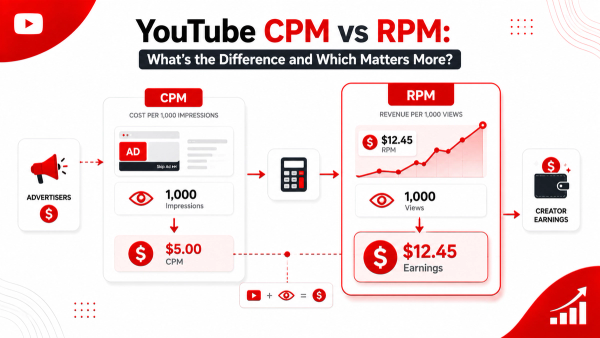
RPM is the abbreviation for revenue per mille, where "mille" means one thousand. On YouTube, it's the average revenue a creator earns for every 1,000 views on their channel. YouTube calculates it from your actual reported earnings across all monetized views in a given period. The beauty of RPM is that it's honest by construction. It divides real earnings by real views, so it automatically accounts for the platform's revenue share, the views that never served an ad, ad blockers, and everything else that reduces what lands in your pocket. When someone asks "what do you earn per 1,000 views?", RPM is the answer they should be asking for.
The YouTube RPM Formula
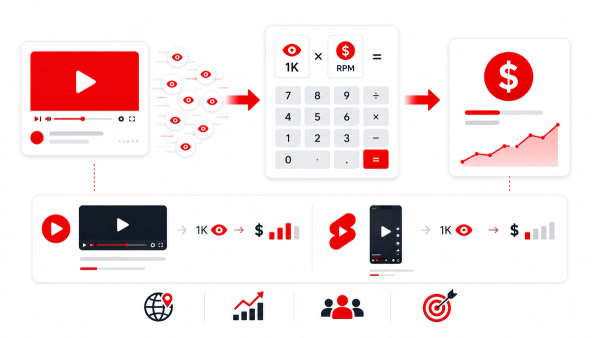
The formula is straightforward: RPM = Estimated earnings ÷ (Views ÷ 1,000) In other words, total earnings divided by total views, scaled to a per-thousand basis. Flip the formula around and you get the one creators use for forecasting: Estimated earnings = Views ÷ 1,000 × RPM If your channel earns $120 from 30,000 views, your RPM is 120 ÷ 30, which equals $4. That means every 1,000 views is producing about $4. Whether that's good or bad depends entirely on your niche and audience — which is exactly what the next sections cover.
RPM vs CPM: What's the Difference?
CPM (cost per mille) and RPM are often confused, and the difference matters. CPM is what an advertiser pays YouTube for 1,000 ad impressions. RPM is what you keep per 1,000 views. Between the two sit YouTube's share — around 45% of long-form ad revenue in 2026 — plus the reality that not every view carries an ad. A concrete example: a channel reports a $25 CPM. Advertisers are paying $25 per 1,000 impressions. But the creator's RPM might be only $7, because YouTube takes its share and only a fraction of views served ads. The CPM tells you about advertiser demand; the RPM tells you about your income. When you're planning finances, negotiating sponsorships, or comparing yourself to other channels, use RPM. The two metrics get a deeper treatment in our CPM vs RPM breakdown.
Why RPM Is More Important for Creators
View counts are seductive, but they don't pay you directly. Two channels can both hit a million views a month and earn wildly different amounts because their RPMs differ. A finance channel at a $15 RPM earns $15,000 from that million views; an entertainment channel at a $2 RPM earns $2,000. Same reach, seven and a half times the income. That's why smart creators track RPM as a performance metric, not just an outcome. A rising RPM means your audience, content, and monetization settings are aligning with advertiser demand. A falling RPM is usually the first warning that something shifted — new audience geography, seasonal budget cuts, or a change in ad load. Views tell you about reach; RPM tells you about value.
What Is a Good YouTube RPM?
There's no universal "good" number, but there are reference points. For long-form content in 2026, an RPM below $2 is on the low side for most niches, $2 to $6 is common for general and entertainment content, $6 to $15 is strong and typical for tech, business, and marketing audiences, and $10 to $25+ shows up in finance with US-heavy audiences. For Shorts, RPMs are far lower — often $0.03 to $0.10 — because of the pooled revenue model. Compare yourself to your own niche and your own history, not to a finance creator with a US audience. A $3 RPM in gaming can be healthy; a $3 RPM in finance would be a warning sign.
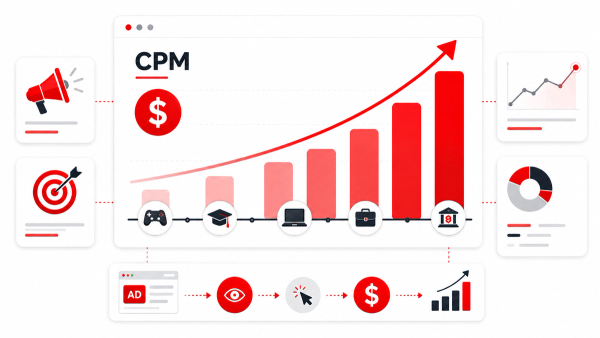
Average RPM by YouTube Niche
The ranges below are 2026 estimates based on advertiser demand per niche. Treat them as starting points, not guarantees.
- Personal finance: $10–$25
- Business and entrepreneurship: $8–$20
- Software and tech: $6–$15
- Digital marketing: $6–$15
- Education: $5–$12
- Health and wellness: $4–$10
- Travel and lifestyle: $2–$6
- Entertainment: $1–$4
- Gaming: $1–$3
- Vlogging: $1–$4
The pattern is consistent: the more money the audience spends, the higher the RPM. Audiences interested in investing, business software, and professional development are worth far more to advertisers per impression.
Average RPM by Country
Your viewers' location drives RPM more than almost anything else. Advertisers bid per market, and some markets pay dramatically more.
- US, Canada, UK, Australia: Highest — frequently 3–10x lower-CPM markets
- Germany, France, Nordic countries: Strong, usually below the US
- Japan, South Korea: Strong for specific niches
- India, Brazil, Southeast Asia: Low per-view, partially offset by volume
A channel with 90% US traffic will earn several times more per view than an identical channel with 90% Indian traffic. That's not a judgment about content quality — it's advertiser economics. If you're building for income, your audience's country mix should be a deliberate part of your strategy.
Why Your RPM Changes
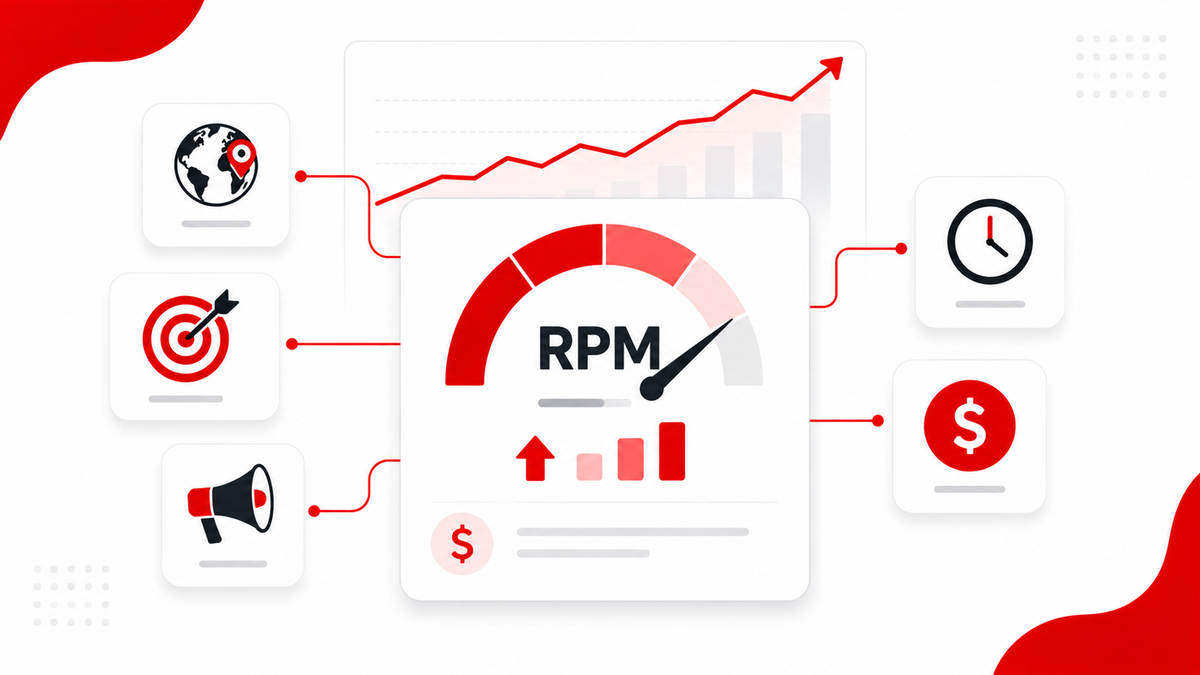
RPM isn't a fixed property of your channel. It's a monthly-moving average shaped by several inputs:
- Audience geography — new viewers from lower-CPM countries drag RPM down
- Ad load — more enabled ad slots usually means higher RPM
- Season — advertiser budgets rise in Q4 and dip after January
- Content mix — a shift toward less advertiser-friendly topics lowers it
- View source — embedded and suggested traffic can monetize differently than search traffic
- Retention — viewers who watch longer see more ads
Because so many inputs move it, a single month's RPM can mislead you. Look at a three-month trend instead of one month in isolation.
How Seasonality Affects RPM
Advertiser budgets follow the calendar. The fourth quarter — October through December — is when brands spend heavily ahead of the holidays, and RPMs climb accordingly. January through March is typically the softest stretch, as budgets reset. Some niches fluctuate more than others: retail, tech, and consumer products swing hard with the shopping calendar, while evergreen education content moves less. What this means practically: don't panic when your RPM drops in February, and don't assume you've cracked it when it spikes in November. Compare like-for-like periods year over year, and plan your biggest content pushes for the high-value quarter.
How Video Length Can Affect RPM
Longer videos tend to earn more per view for mechanical reasons. Videos over 8 minutes can carry mid-roll ads, which multiplies ad impressions per viewer. A viewer who finishes a 12-minute video may encounter two or three ad breaks; a viewer of a 3-minute video sees one pre-roll at most. Length only helps if watch time is preserved. A 20-minute video that loses most viewers in the first two minutes earns less than a tight 10-minute video people finish. Retention is the real driver; length is the lever that converts strong retention into more paid impressions.
How Audience Demographics Affect RPM
Beyond country, who your viewers are matters. Advertisers pay more to reach audiences with disposable income and clear purchase intent. A channel whose viewers are predominantly working adults with spending power earns higher rates than one whose audience skews very young or low-income, all else being equal. This shows up in practice as a feedback loop: content that attracts a valuable demographic tends to attract higher-paying advertisers, which raises RPM, which makes the channel more sustainable. It's one more reason to know your audience deeply rather than chasing raw reach.
10 Ways to Increase Your YouTube RPM
- Pull your real RPM from Studio — Analytics → Revenue — before you change anything, so you know your baseline.
- Attract high-CPM countries — topics, titles, and language that appeal to US, UK, Canadian, and Australian viewers.
- Move toward advertiser-friendly niches — finance, business, software, and education command higher rates.
- Publish longer videos people actually finish — 8+ minutes with natural mid-roll placement.
- Raise retention — a video people complete serves more ads per view.
- Enable all eligible ad formats — skippable, non-skippable, overlay, and mid-roll where appropriate.
- Place mid-rolls at natural chapter breaks — aggressive placement hurts retention and can backfire.
- Steer clear of limited-ad content — YouTube restricts ads on certain topics, which caps RPM.
- Watch seasonality — time major uploads and promotions for Q4.
- Build topic authority — a channel known for a valuable niche attracts both algorithmic distribution and brand interest.
Use the Thumbix RPM Calculator
Rather than doing the math by hand every time, use the free Thumbix RPM Calculator. Enter your estimated earnings and view count, and it returns your RPM instantly — then flip it around to forecast earnings from views and an RPM. It pairs naturally with the CPM Calculator, the YouTube Money Calculator for full revenue modeling, and the Ad Revenue Calculator for deeper projections. All of them are estimates built on the same formula, so the output is honest rather than hyped.
RPM Examples With Realistic Calculations
Let's walk through a few worked examples. These are illustrative scenarios, not guarantees. Example 1. A finance channel earns $1,800 from 120,000 views. RPM = 1,800 ÷ (120,000 ÷ 1,000) = $15. Every 1,000 views is worth $15. Example 2. A vlog channel earns $90 from 45,000 views. RPM = 90 ÷ 45 = $2. This is normal for the niche — and it's why vloggers typically need merchandise, sponsorships, or products on top of ads. Example 3. A gaming channel wants to know what 200,000 views would earn at a $2.50 RPM. Estimated earnings = 200,000 ÷ 1,000 × 2.5 = $500. If they improve retention and shift to more advertiser-friendly topics, a $4 RPM would turn the same views into $800. The point of running these numbers is to make decisions with a realistic picture — not to lock in a number and treat it as destiny.
Conclusion
RPM is the clearest window into whether your channel is actually making money per view. It strips away the confusion of view counts and CPM talk and tells you the number that reaches your balance. Track it, understand what moves it, and treat it as something you can improve — because you can. Start by pulling your real RPM from Studio, then work the ten levers above. For quick math on the go, the Thumbix RPM Calculator does the heavy lifting. Want to know what your views are really worth? Run your earnings and view count through the free Thumbix RPM Calculator — and check the YouTube Money Calculator to model your monthly and yearly revenue.
Frequently Asked Questions
What is YouTube RPM?
RPM stands for revenue per mille — the average revenue a channel earns for every 1,000 views, after YouTube's revenue share and deductions.
How is YouTube RPM calculated?
RPM equals estimated earnings divided by views, scaled per thousand: RPM = estimated earnings ÷ (views ÷ 1,000). YouTube shows it in Studio under Analytics → Revenue.
What is the difference between RPM and CPM?
CPM is what advertisers pay per 1,000 ad impressions. RPM is what you keep per 1,000 views after YouTube's cut and views that didn't serve an ad.
What is a good RPM on YouTube?
For long-form content, below $2 is low for most niches, $2–$6 is common, $6–$15 is strong, and finance channels with US-heavy audiences can exceed $20.
Why did my YouTube RPM go down?
Usually because of new viewers from lower-CPM countries, seasonal budget declines, a less advertiser-friendly content mix, or fewer ads on recent videos.
Is Shorts RPM the same as long-form RPM?
No. Shorts monetize through a shared revenue pool and typically earn $0.03 to $0.10 per 1,000 views, far below most long-form RPMs.
How can I increase my YouTube RPM?
Attract audiences from high-CPM countries, publish advertiser-friendly content, improve retention, enable all eligible ad formats, and place mid-rolls at natural breaks.
Should I use my own RPM or industry averages?
Use your own RPM from YouTube Studio whenever you have it. Industry ranges are only a starting point before you have enough channel data.