
Table of Contents
- Introduction
- Quick Answer
- Why 1 Million Views Does Not Have a Fixed Value
- Calculate 1 Million Views Using RPM
- Earnings at Different RPM Levels
- Earnings by Niche
- Earnings by Country
- Long-Form vs Shorts
- Monetized vs Non-Monetized Views
- Does 1 Million Views Guarantee $X?
- Use the Thumbix YouTube Money Calculator
- How to Turn 1 Million Views Into More Revenue
- Frequently Asked Questions
- How Long Does It Take to Get 1 Million Views?
- Three Channels, Three Very Different Million-View Results
- After the Million: Turning Views Into a Channel
- The Difference Between a Million-View Video and a Million-View Channel
- Conclusion
1 million views on YouTube can earn anywhere from $1,000 to $15,000 or more — the range is entirely driven by RPM. Here's the exact math and what it means.
Introduction
A million views feels like a milestone worth celebrating — and it is. But ask how much money it actually brings, and you'll hear everything from "a few hundred dollars" to "$50,000." Both answers can be true, because a million views doesn't have a price tag. It has a range, and the range is determined by one number: your RPM. At a $1 RPM, a million views earns $1,000. At a $6 RPM, it's $6,000. At a $15 RPM, it's $15,000. Same views, fifteen times the money. This guide explains why that's the case, what a million views is realistically worth by niche and country, how Shorts compare, and how to push your million views toward the top of the range.
Quick Answer
In 2026, a million long-form views typically earns between $1,000 and $10,000 for most creators, with high-RPM niches like finance and business reaching $15,000 or more. Shorts pay far less — often $30 to $100 per million views. The exact number depends on RPM, which is shaped by niche, audience country, video length, retention, and season.
Why 1 Million Views Does Not Have a Fixed Value
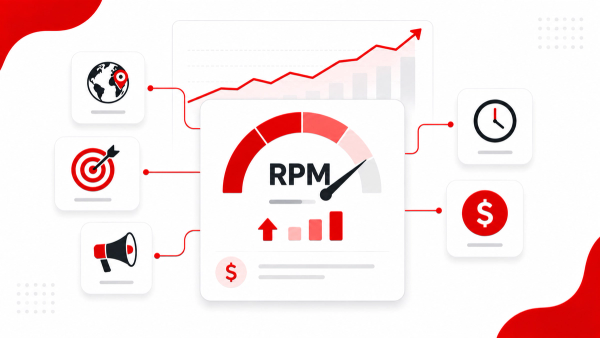
YouTube doesn't pay a flat rate per view, so there's no fixed value for a million of them. What you earn is a share of the ad revenue your viewers generate, and that depends on:
- How much advertisers are paying for your audience (CPM)
- What percentage of your views actually serve an ad
- How many ads each viewer sees before leaving
- YouTube's revenue share
- The season and current advertiser demand
All of that gets compressed into RPM, and RPM is the only number you need to value a million views.
Calculate 1 Million Views Using RPM
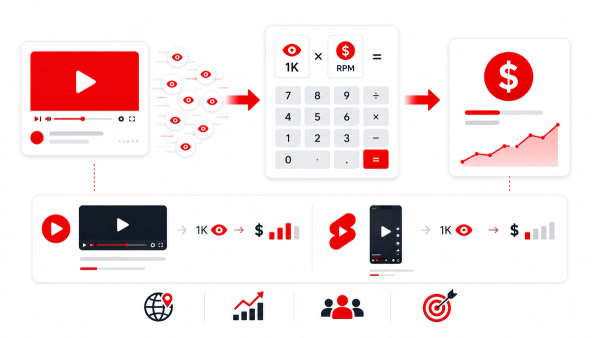
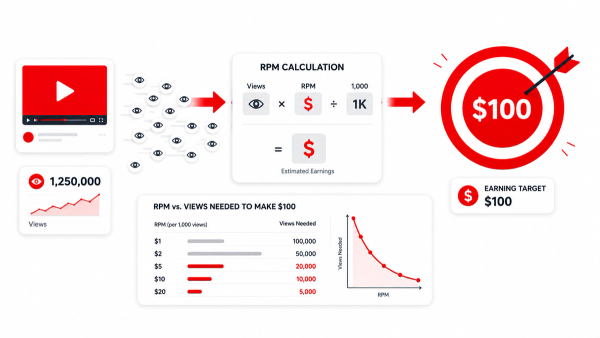
The formula is the same one used throughout this site: Estimated earnings = Views ÷ 1,000 × RPM For a million views: 1,000,000 ÷ 1,000 × RPM = 1,000 × RPM So the math collapses to: earnings from 1M views equals 1,000 times your RPM. At a $4 RPM, that's $4,000. At a $12 RPM, that's $12,000. Simple, honest, and entirely dependent on the RPM you bring to the table.
Earnings at Different RPM Levels
The table below shows what one million long-form views earns across realistic 2026 RPM levels. These are illustrative calculations, not guarantees.
- $1: $1,000
- $2: $2,000
- $4: $4,000
- $6: $6,000
- $8: $8,000
- $10: $10,000
- $15: $15,000
- $20: $20,000
- $25: $25,000
The takeaway isn't the numbers themselves — it's the multiplier. A channel that improves its RPM from $2 to $10 turns the same million views into five times the income.
Earnings by Niche
Applying typical niche RPMs to a million views gives a realistic picture of what each niche's ad revenue looks like. These are 2026 estimates.
- Personal finance: $10–$25, $10,000–$25,000
- Business: $8–$20, $8,000–$20,000
- Software and tech: $6–$15, $6,000–$15,000
- Education: $5–$12, $5,000–$12,000
- Health and wellness: $4–$10, $4,000–$10,000
- Travel and lifestyle: $2–$6, $2,000–$6,000
- Entertainment: $1–$4, $1,000–$4,000
- Gaming: $1–$3, $1,000–$3,000
A million views in finance is a genuinely life-changing month for some. The same million views in gaming might cover a few months of editing software. Neither is a failure — they're different economies.
Earnings by Country
Where your million viewers live matters almost as much as the niche. A US-heavy audience is frequently worth 3–10 times more per view than an audience concentrated in lower-CPM markets. Two channels, both at a million views:
- A channel with 90% US traffic at a $12 RPM: about $12,000
- A channel with 90% Indian traffic at a $1.50 RPM: about $1,500
The content doesn't have to differ at all. The advertisers bidding on those audiences do.
Long-Form vs Shorts
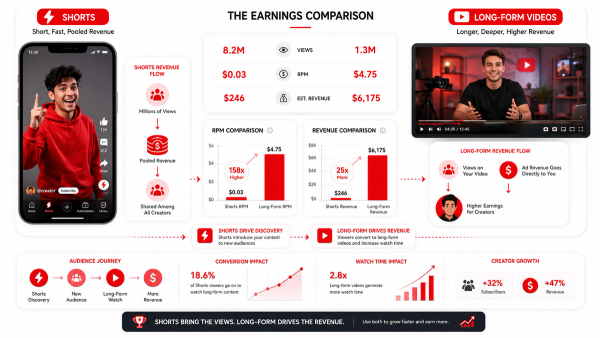
Shorts change the entire calculation because they monetize through a pooled revenue model rather than per-video ads. A million Shorts views typically earns $30 to $100 — often around $0.05 per 1,000 views. By comparison, a million long-form views in even a mid-tier niche earns thousands. This isn't an argument against Shorts. A Short that pulls a hundred thousand viewers is a fantastic funnel into your long-form videos, subscribers, and products. It's just not a direct revenue play at the same scale as long-form.
Monetized vs Non-Monetized Views
The million-view number on your public counter isn't the same as the million-view number YouTube uses for revenue. Only monetized views — views that serve an ad — contribute to earnings. Your RPM already accounts for this, which is why the formula works. If you're estimating from a public view count, remember that some percentage of those views never produced an ad impression.
Does 1 Million Views Guarantee $X?
No. No view count guarantees a dollar figure, and anyone promising otherwise is selling something. Earnings depend on the factors above plus the messy reality of seasonality and ad inventory. What you can rely on is the structure: 1,000 × your RPM gives you the honest estimate for a million views. That estimate is useful for planning, forecasting, and setting expectations — not for promises.
Use the Thumbix YouTube Money Calculator
Instead of multiplying by hand, the Thumbix YouTube Money Calculator lets you enter views and RPM to see estimated earnings per video, per 1,000 views, and across a year. The Revenue Per Video Calculator gives you a per-video figure directly, the RPM Calculator confirms your RPM from earnings and views, and the CPM Calculator helps you understand the advertiser side. All of them are estimates built on the same formula covered in this article.
How to Turn 1 Million Views Into More Revenue
Ad revenue is the baseline, not the ceiling. Creators who get the most out of their views layer income on top:
- Funnel viewers into a product or service — a course, template, or consulting offer
- Use affiliate links relevant to your content
- Pitch sponsorships once you can demonstrate consistent reach and engagement
- Drive subscribers into a membership or email list
- Repurpose long-form into Shorts to expand reach and pull new viewers up the funnel
The channel earning $15,000 from a million views in ad revenue can often double or triple it with the right stack on top.
How Long Does It Take to Get 1 Million Views?
A million views can arrive in a week or take years. The realistic paths:
- A breakout video. One video that gets recommended aggressively can pass a million views in weeks. These are usually high-engagement, high-retention videos in topics with genuine demand.
- A compounding library. Most channels reach a million total views not from one hit, but from dozens of steady videos. At 5,000 views per video with weekly uploads, a million views takes about four years; at 20,000 per video, about a year.
- The Shorts path. Shorts can cross a million views quickly, but the same million earns a fraction of what long-form produces.
The honest framing: million-view channels are more common than million-view videos. Total channel views are what most creators actually build.
Three Channels, Three Very Different Million-View Results
Realism beats averages, so consider three channels, all at a million views:
- A finance channel at an $18 RPM: roughly $18,000 from ads alone.
- A tech review channel at a $9 RPM: roughly $9,000.
- A gaming channel at a $2 RPM: roughly $2,000.
All three are legitimate outcomes. The finance channel wins the ad revenue game; the gaming channel usually wins the reach and subscriber game. That's why comparing revenue without comparing niche and audience is meaningless — and why your RPM, not someone else's, is the number that prices your million views.
After the Million: Turning Views Into a Channel
A million views is a moment; a channel is a system. The creators who turn one million into the next one focus on repeatability:
- Identify what the breakout video had in common with your library — topic, format, packaging — and make more of that.
- Convert the attention into subscribers with clear next steps in the video and a consistent upload schedule.
- Turn the audience into revenue beyond ads: memberships, products, sponsorships.
- Keep an eye on retention. A million views earned with great retention is worth more than a million earned with viewers who left early.
Treat the million as a signpost, not a destination, and the next milestone comes from the work in between. One more angle worth noting: your first million views is also your best data set. You'll know which topics, thumbnails, and formats earned the most watch time, and you can build your next million from that evidence instead of guesswork. A second million is almost always cheaper to earn than the first, because the audience and the analytics already exist. Beyond ads, that data also fuels your sponsorship pitch: a million-view track record with real retention is exactly the proof brands pay for. Treat the milestone as leverage, not decoration. Use it, and the next one comes faster.
The Difference Between a Million-View Video and a Million-View Channel
A single video that hits a million views is an event. A channel with a million total views is a system. The difference shapes how you should think about the milestone:
- A viral video is often a packaging win — the topic, title, and thumbnail hit a broad need. It can make money and grow subscribers fast, but it's rarely repeatable on its own.
- A million-view channel is built from average videos that each do their job, supported by consistent uploads, retention, and a clear niche.
The most useful question isn't "when will I hit a million views?" but "which system am I building?" Viral luck plus a strong system compounds; viral luck alone doesn't.
Conclusion
A million views is a milestone worth chasing, but the money in it is set by RPM, not by the view count. Understand the formula, know your niche and audience, and stack revenue streams on top of ads. Do that, and a million views stops being a vanity metric and becomes a real number you can plan around. Curious what your next million views are worth? Run your RPM through the free Thumbix YouTube Money Calculator to see the estimate per video, per 1,000 views, and per year.
Frequently Asked Questions
How much money does 1 million YouTube views make?
For long-form content, typically $1,000 to $10,000 depending on RPM, with high-RPM niches like finance reaching $15,000 or more. Shorts typically earn $30 to $100 per million views.
How do you calculate earnings from 1 million views?
Use the formula: earnings = views ÷ 1,000 × RPM. For one million views, that simplifies to 1,000 × your RPM.
Do Shorts pay the same per million views?
No. Shorts monetize through a pooled revenue model and typically pay $30 to $100 per million views, far below long-form.
Why did my million-view video earn less than I expected?
The most common reasons are a low-RPM niche, viewers from lower-CPM countries, low ad fill, or seasonal advertiser budget declines. Check your actual RPM in YouTube Studio.
Does a million views guarantee a payout?
For monetized long-form content, almost always yes, since it far exceeds the $100 AdSense threshold. But the exact amount depends entirely on RPM.
Which niche earns the most from a million views?
High-RPM niches like personal finance and business, where a million views can earn $10,000 to $25,000 or more.
Can I make more than ad revenue from a million views?
Yes. Sponsorships, affiliate marketing, products, and memberships typically outperform ad revenue for established channels.