Table of Contents
- Introduction
- Quick Answer
- The Basic YouTube Earnings Formula
- How RPM Changes the Number of Views Needed
- $2 RPM Example
- $5 RPM Example
- $10 RPM Example
- $20 RPM Example
- How Many Views for $100 by Niche?
- How Many Shorts Views for $100?
- Why Some Channels Need More Views
- How to Calculate Your Personal Number
- Frequently Asked Questions
- Realistic Timeframes to Reach $100
- Three Paths to Your First $100
- Turning Your First $100 Into Momentum
- How the $100 Threshold Works and Why It Exists
- Conclusion
At a $5 RPM, you need 20,000 monetized views to make $100. At $2.50, it's 40,000. Here's the exact formula and how to find your personal number.
Introduction
Every new creator has a version of this goal: the first $100. It's small enough to feel reachable and large enough to prove the channel is real. The honest answer is that there's no single view count — it depends on your RPM, the amount you earn per 1,000 views. At a typical $2.50 RPM, you'd need about 40,000 monetized views. At a strong $10 RPM, you'd need just 10,000. Same $100, four times the views. This article walks through the formula, gives you exact numbers across realistic RPM levels, breaks it down by niche and format, and shows you how to calculate your own personal figure instead of guessing.
Quick Answer
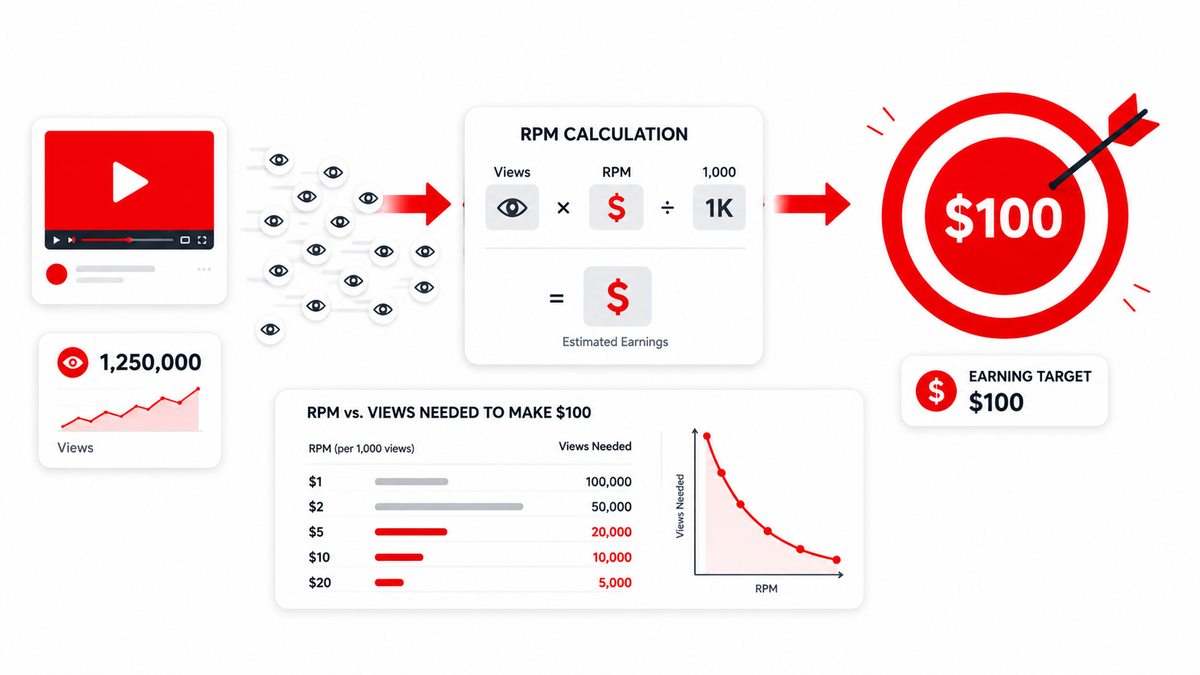
To make $100 on YouTube, divide 100 by your RPM and multiply by 1,000. At a $2 RPM that's 50,000 views; at $5, it's 20,000; at $10, it's 10,000; at $20, it's 5,000. For Shorts, the picture is different: with a typical $0.05 RPM, you'd need around 2 million Shorts views. These figures assume monetized views that actually serve ads — the RPM already accounts for that.
The Basic YouTube Earnings Formula
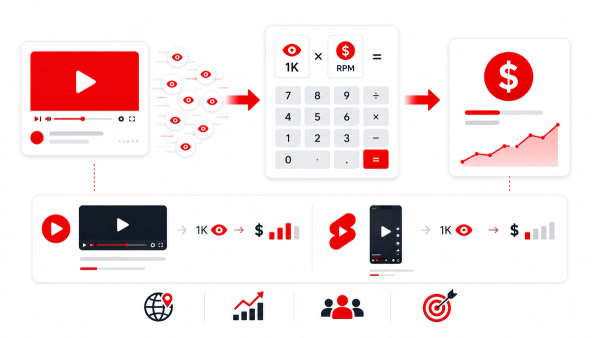
The math behind every answer in this article is the same formula: Estimated earnings = Views ÷ 1,000 × RPM Flip it around to solve for views: Views needed = $100 ÷ RPM × 1,000 The second version is the one you'll use constantly. If your RPM is $4, then 100 ÷ 4 × 1,000 = 25,000 views. The higher your RPM, the fewer views you need — which is why channel economics improve so dramatically when creators move to higher-paying niches and audiences.
How RPM Changes the Number of Views Needed
RPM is the single biggest variable in the equation, and it ranges widely. Long-form RPM in 2026 typically falls between $1 and $20+ depending on niche and audience country. The table below shows exactly how much the view count changes as RPM moves:
- $1: 100,000
- $2: 50,000
- $4: 25,000
- $6: ~16,700
- $8: 12,500
- $10: 10,000
- $15: ~6,700
- $20: 5,000
One channel needs 100,000 views to earn $100; another needs 5,000. Both are normal for their niches. This is why raw view counts tell you so little about a channel's income.
$2 RPM Example
A $2 RPM is common for gaming, entertainment, and general vlogging channels, especially with a mix of lower-CPM countries. To earn $100: 100 ÷ 2 × 1,000 = 50,000 views That's the arithmetic. In practice, this means a channel averaging 2,000 views a day would need 25 days to reach $100 from ad revenue alone. It's a slow climb — which is exactly why channels in low-RPM niches usually pair ads with sponsorships, merchandise, or products.
$5 RPM Example
A $5 RPM represents a solid mid-tier channel — say, tech or lifestyle content with a healthy US and UK audience. To earn $100: 100 ÷ 5 × 1,000 = 20,000 views A channel averaging 1,000 views a day reaches $100 in about 20 days. A single video that does 20,000 views in a week gets you there on its own. This is the RPM level where ad revenue starts feeling like a real, if modest, income stream.
$10 RPM Example
A $10 RPM is strong — typical of business, digital marketing, and finance-adjacent content with predominantly Western audiences. To earn $100: 100 ÷ 10 × 1,000 = 10,000 views Ten thousand views is a very achievable milestone for a mid-size channel, which is why high-RPM creators reach the $100 payout so much faster. A handful of videos a month can clear it consistently.
$20 RPM Example
A $20 RPM is the top of the typical range, seen in personal finance and some business niches with heavy US traffic. To earn $100: 100 ÷ 20 × 1,000 = 5,000 views Five thousand views for $100 means a single modestly performing video can hit the goal. At this level, a channel that publishes weekly and averages 10,000 views a video could bank $200 a week from ads alone — before a single sponsorship or product sale.
How Many Views for $100 by Niche?
Here's the same $100 goal applied to typical long-form RPM ranges by niche. These are 2026 estimates, not guarantees:
- Personal finance: $10–$25, ~4,000–10,000
- Business: $8–$20, ~5,000–12,500
- Software and tech: $6–$15, ~6,700–16,700
- Education: $5–$12, ~8,300–20,000
- Health and wellness: $4–$10, ~10,000–25,000
- Travel and lifestyle: $2–$6, ~16,700–50,000
- Entertainment: $1–$4, ~25,000–100,000
- Gaming: $1–$3, ~33,000–100,000
Notice the spread: a finance channel and a gaming channel can both want $100, but one needs a tenth of the views. Neither is wrong — they're just operating in different advertising markets.
How Many Shorts Views for $100?
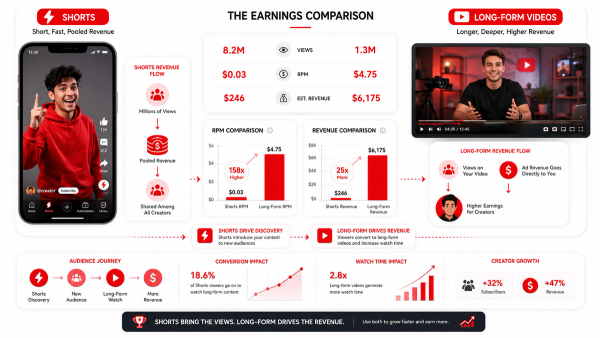
Shorts run on a pooled revenue model, and their RPM is far lower — often $0.03 to $0.10 per 1,000 views. Using a typical $0.05 RPM: 100 ÷ 0.05 × 1,000 = 2,000,000 views At a more optimistic $0.10 RPM, it's still a million views. This is the reality check most Shorts-first creators eventually hit: direct ad revenue from Shorts alone is a volume game with very thin margins. The smart strategy for most channels is to use Shorts as a discovery engine that funnels viewers into longer, higher-RPM content — not to count on Shorts for the payout.
Why Some Channels Need More Views
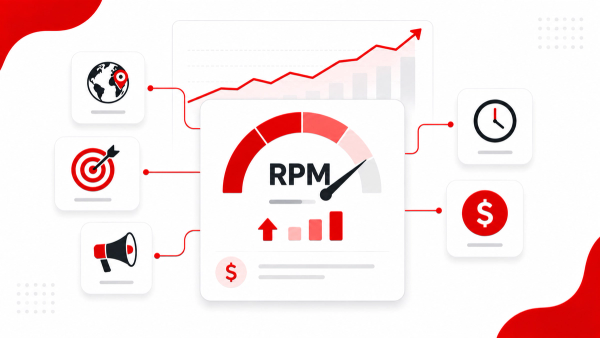
You'll sometimes see two channels with identical view counts earn wildly different amounts, and the reasons all trace back to RPM:
- Audience country — viewers in lower-CPM markets earn far less per view
- Ad fill rate — not every view serves an ad
- Video length — longer videos carry more ad opportunities
- Retention — viewers who stay longer see more ads
- Seasonality — earnings dip in low-advertising months
- Niche — advertiser demand varies massively
None of these are failures. They're inputs. Once you understand them, you can start moving the ones you control.
How to Calculate Your Personal Number
Your real RPM is in YouTube Studio under Analytics → Revenue. Plug it into the formula and you have your personal answer. Rather than doing the math by hand, the Thumbix YouTube Money Calculator and Revenue Goal Calculator work backward from your target income to show the views you'd need, and the Daily Views Calculator converts that into a per-day target. The RPM Calculator is useful if you know your earnings and views and want to confirm the RPM you're working with. All of these produce honest estimates — your real numbers depend on your actual monetized views.
Realistic Timeframes to Reach $100
How long it takes to earn your first $100 depends on your RPM and how many views you produce. A channel averaging 20,000 views a month at a $5 RPM earns about $100 a month — meaning the milestone lands in roughly a month, assuming the balance starts from zero. At 5,000 views a month and a $3 RPM, it's about seven months. Shorts-heavy channels face a longer wait, because at Shorts rates $100 can represent millions of views. The $100 threshold is a pacing problem, not a profitability problem. If you're close to it and planning to keep uploading, the balance will get there. The creators who get discouraged are usually the ones who stopped earning right before the payout arrived.
Three Paths to Your First $100
- The high-RPM route. Pick a monetizable niche with strong advertiser demand — finance, business, software, education. Fewer views, higher per-view value, faster to $100. This is the patient route to quality audiences.
- The volume route. Produce consistent, searchable content in a broader niche and push view counts. You need more views at a lower RPM, but the math still works if you can sustain uploads.
- The hybrid route. Use Shorts to build reach and subscribers quickly, then channel that audience into longer, higher-RPM videos. Shorts themselves earn little, but the funnel they create is where the $100 actually comes from.
None of these is "better" in the abstract — they match different strengths. What they share is that each one targets a number you can calculate in advance.
Turning Your First $100 Into Momentum
Your first $100 is validation, not a career. The creators who treat it as a starting point keep building: reinvest a little in editing tools, use the momentum to set a revenue goal for the next three months, and study which videos actually carried you across the threshold. The view that earned you a dollar is the view worth replicating. And once you've hit $100, you already have the habit that gets you to $500 — track the number, learn what drives it, and keep the formula honest.
How the $100 Threshold Works and Why It Exists
AdSense pays only when your balance reaches $100, then typically once a month after a 21-day hold. The threshold exists because processing small international payments costs real money — for Google and for you. That's also why your revenue from memberships, Supers, and Premium watch time all roll into the same balance: the fastest way to reach $100 is to use every revenue feature you're entitled to, not just ads. Some creators hit $100 in their first month; others wait six. Either way, the money isn't lost — it's parked until it crosses the line. A practical note for planning: check your AdSense account monthly, not daily. Watching the balance creep up at the pace a small channel earns can be discouraging if you expect speed. Instead, set a quarterly review — upload consistently, watch your RPM trend, and judge your progress against the quarter before. Patience with the threshold is part of the job; the creators who reach it are the ones who treated it as inevitable, not optional.
Conclusion
The number of views you need to make $100 isn't a magic constant — it's a division problem built on your RPM. The faster route isn't always more views; it's a higher RPM through better niches, audiences, and retention. Pull your real number from Studio, plug it into the formula, and you'll know exactly where your first $100 comes from. Ready to find your number? Enter your RPM and target in the free Thumbix Revenue Goal Calculator to see exactly how many views you need to hit $100 — and beyond.
Frequently Asked Questions
How many views do I need to make $100 on YouTube?
It depends on your RPM. At $2 RPM you need 50,000 views; at $5, 20,000; at $10, 10,000. Use the formula: 100 ÷ RPM × 1,000.
How many Shorts views make $100?
At a typical Shorts RPM of $0.05, roughly 2 million views. At $0.10, about 1 million views.
What is YouTube's minimum payout?
The AdSense payout threshold is $100. Your earnings transfer once your available balance reaches that amount.
Do all views count toward earnings?
No. Only monetized views that serve an ad contribute. Your RPM already reflects this, which is why it's the right figure to calculate with.
How long does it take to earn the first $100?
At 1,000 views a day with a $5 RPM, roughly 20 days. At a $1 RPM, about 100 days. It scales directly with RPM.
Can I make $100 without being monetized?
Yes. Sponsorships, affiliate marketing, and digital products don't require YPP. But those are separate income streams from ad revenue.
Which niche needs the fewest views for $100?
High-RPM niches like personal finance and business, where $100 can come from as few as 4,000–10,000 views.