Table of Contents
- Introduction
- The Short Answer: Different Games
- How Shorts Monetization Works (The Pooled Model)
- How Long-Form Monetization Works (Per-Video Ads)
- Shorts vs Long-Form: Per 1,000 Views Comparison Table
- What Shorts Are Actually For: Discovery, Not Income
- The Subscriber and Watch-Hours Math
- The 60-Second Rule and What It Means
- The Strategy: Use Both Formats Correctly
- Model Your Own Mix With the Calculators
- Frequently Asked Questions
- Final Takeaway
Shorts typically earn $0.03 to $0.15 per 1,000 views while long-form earns $2 to $20 depending on niche, but Shorts also feed subscribers into your long-form videos. Here is the honest math and the strategy.
The direct answer is that long-form makes far more money per view, and the complete answer is that Shorts still matter. In 2026, long-form video in a decent niche earns roughly $2 to $20 RPM depending on topic and audience, while Shorts typically earn $0.03 to $0.15 per 1,000 views through the pooled revenue model. That is a 20 to 100 times difference in per-view income. Yet Shorts remain one of the fastest ways to grow a channel, because their job is discovery and subscriber acquisition, not income. The channels that make the most money use both, and they use each format for what it is actually good at. This article lays out the honest money math for both formats, explains why the difference exists, and shows you how to model your own mix with free calculators instead of guessing.
Introduction
The Shorts versus long-form debate usually gets framed as a choice, as if every creator must declare a side. In practice it is not a choice; it is a funnel. Shorts are the front door that brings new viewers in cheaply, and long-form is the room where the money is made. The creators who lose money on the argument are the ones who treat Shorts as an income strategy or long-form as a growth strategy, when the reality is the reverse. So the real question is not which format pays more; it is how much each format pays, what each one costs to produce, and how the two work together. This article answers all three, with 2026 numbers and the honest caveat that every figure is an estimate.
The Short Answer: Different Games
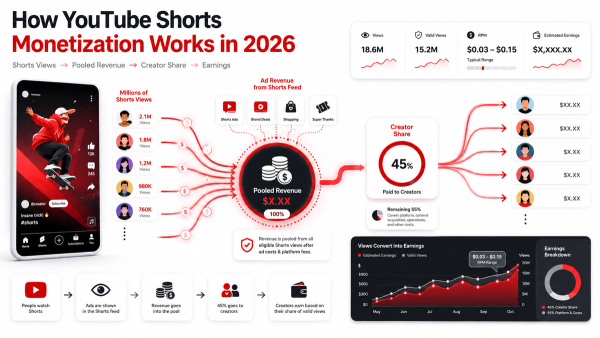
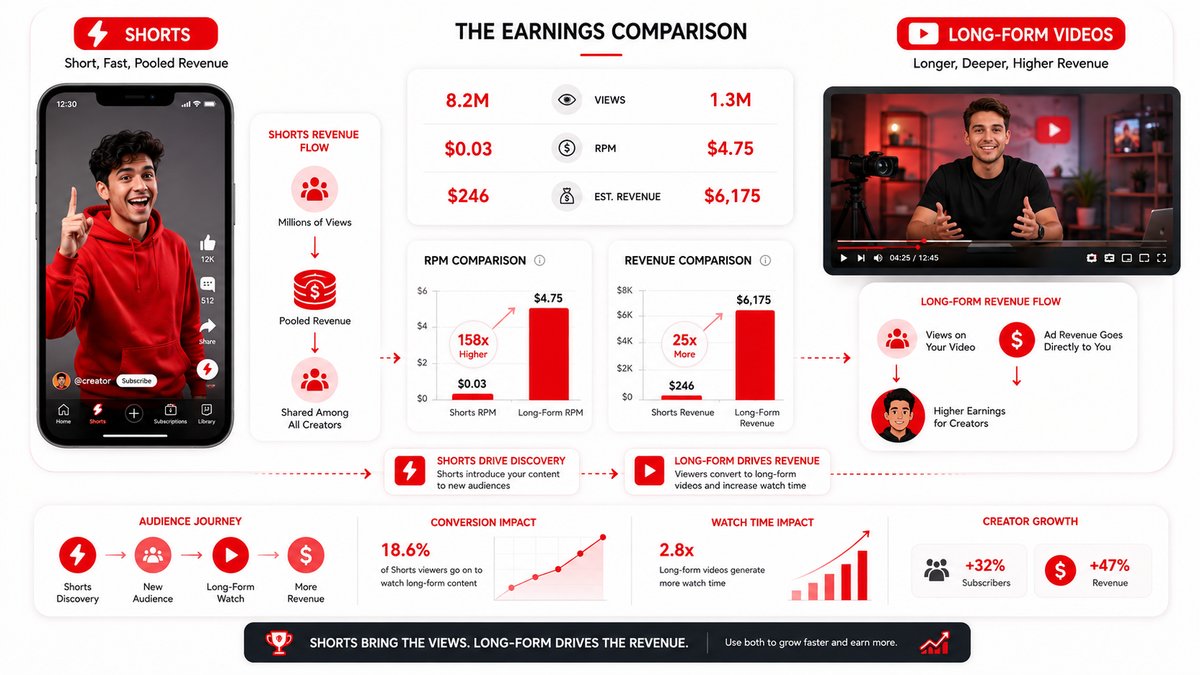
Long-form monetizes through ads served on and around your videos, and the creator keeps 55 percent of that ad revenue. Shorts monetize through a monthly creator pool distributed to eligible Shorts based on views and engagement, with the creator keeping 45 percent of their allocated share. The two models produce radically different economics. On long-form, a $5-RPM video earns $5 per 1,000 monetized views. On Shorts, a typical video earns $0.03 to $0.15 per 1,000 views. To earn $100 from Shorts at the top of that range, you need roughly 667,000 views; to earn $100 from long-form at a $5 RPM, you need 20,000. That is the difference the two formats really have, and it is why no serious creator describes Shorts as a primary income source. The caveat is volume. Shorts are cheap to produce and can accumulate millions of views in ways long-form almost never does, so the per-view gap does not mean Shorts earn nothing. It means Shorts earn their keep as a growth engine, not as a paycheck.
How Shorts Monetization Works (The Pooled Model)
Shorts revenue in 2026 is built on a monthly pooled model. YouTube allocates a revenue pool based on its earnings from Shorts ads, then distributes it to eligible Shorts creators according to each creator's share of total Shorts viewing on the platform. The creator keeps 45 percent of the pool allocated to them, and the rest goes to YouTube. The practical result is that individual Shorts earnings are hard to predict, because your income depends on the whole platform's Shorts pool in a given month, not on the ads that happen to run on your own video. This is why Shorts RPM is quoted as a range: $0.03 to $0.15 per 1,000 views, with higher figures in months when the pool is larger and your audience geography is favorable. To earn on Shorts, you must be in the YouTube Partner Program and meet the Shorts-specific monetization policies, and your Shorts must be original. Copy-paste reuploads and low-effort AI Shorts are exactly what the policies and the 2025 cleanup wave target.
How Long-Form Monetization Works (Per-Video Ads)
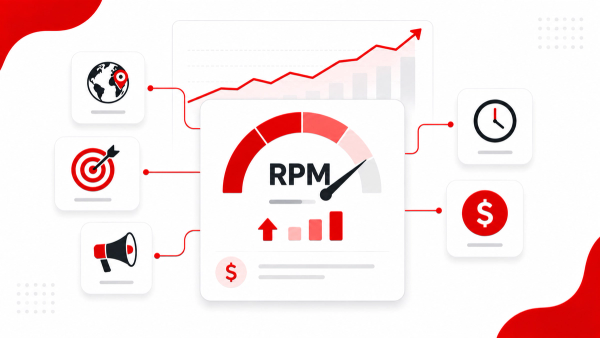
Long-form monetization is far more direct. Ads run before, during, and after your video, advertisers bid per impression, and your revenue is the sum of what those ads earn, from which you keep 55 percent. Because revenue follows your own video's ads, long-form RPM is driven by your niche, your audience's country, your video length, and your retention. A finance long-form video can earn $8 to $20 or more per 1,000 monetized views. Education and science sit near $10. History and true crime run $3 to $8, and gaming and entertainment often land under $5. Audience geography multiplies the base: viewers in the US, UK, Canada, and Australia are typically worth 3 to 10 times more per view than developing markets. Long-form also rewards length and completion. Videos over eight minutes can host mid-roll ads, and viewers who finish more of the video see more ads, which is why average view duration is a revenue metric as much as a quality metric.
Shorts vs Long-Form: Per 1,000 Views Comparison Table
The table below compares the two formats at a glance. All figures are 2026 estimates.
- Typical RPM: $0.03 - $0.15, $2 - $20
- Revenue model: Shared monthly pool, Per-video ad impressions
- Creator keeps: 45% of allocated pool, 55% of ad revenue
- Views for $100: ~667,000 at best, 5,000 - 50,000
- Max length: 60 seconds, 8+ minutes for mid-rolls
- Primary job: Discovery and subscribers, Income and depth
- Production cost: Low, High
- Watch hours earned: Counts less, Counts most
Read the table as two different businesses. Shorts move viewers in bulk at low cost; long-form converts those viewers into watch hours and revenue. A channel that picks one and ignores the other is leaving half the machine idle.
What Shorts Are Actually For: Discovery, Not Income
The clearest way to think about Shorts is as a free discovery ad for your channel. A well-made Short can get millions of views with zero ad spend, and a fraction of those viewers become subscribers. Those subscribers then watch your long-form videos, where the real RPM lives. The numbers explain why this matters. A Short with 500,000 views at a $0.10 RPM earns $50. If that same Short converts even one percent of viewers into subscribers and a quarter of those subscribers watch one long-form video a week, the long-form revenue from that audience will dwarf the Short's direct earnings within a quarter. Shorts also feed the algorithm's understanding of your channel. Consistent Shorts activity signals momentum, and in a new channel that signal can be the difference between slow growth and a breakout. Treat Shorts as the acquisition channel and long-form as the monetization channel, and the whole picture gets clear.
The Subscriber and Watch-Hours Math
The formats also differ in how they help you reach monetization. The full YouTube Partner Program tier requires 1,000 subscribers plus either 4,000 public watch hours in 12 months or 10 million Shorts views in 90 days. The early-access tier needs 500 subscribers, 3 uploads in 90 days, and either 3,000 watch hours or 3 million Shorts views, but unlocks fan funding only. Shorts are the fastest subscriber engine, because they reach the broadest audience. But Shorts views barely move the watch-hours dial compared with long-form, which is why the two targets favor different paths. A long-form-first channel clears watch hours steadily; a Shorts-first channel races through the views threshold while watch hours lag. The winning combination in practice is a steady stream of long-form for watch hours plus Shorts for the subscriber count, which is how most channels close both numbers in 4 to 8 months. Keep the YouTube Partner Program requirements in mind as you choose your mix, because the format you emphasize changes which threshold you hit first.
The 60-Second Rule and What It Means
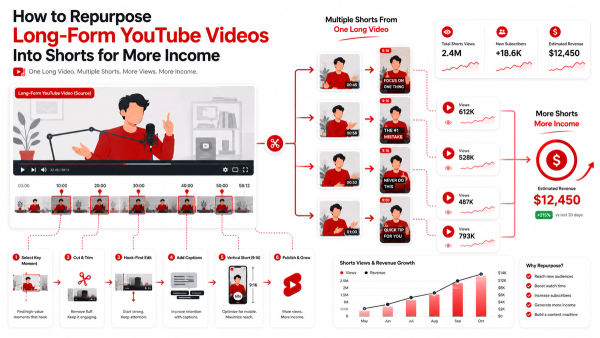
Since October 2025, Shorts can be up to 60 seconds long, an extension from the earlier 3-minute limit that was rolled back. In 2026 the effective rule for most creators is: vertical 9:16 video up to 60 seconds qualifies as a Short, and anything past that threshold is long-form, which changes both monetization and discovery. The practical takeaway is more room per Short. A 45-second hook is plenty for most clips, and the extra headroom lets you keep context that a 15-second cut would lose. But longer Shorts raise the retention bar: a viewer who would watch a 15-second clip to the end is far less likely to finish 55 seconds, and retention is a huge factor in Shorts distribution. Cut ruthlessly and keep the first two seconds genuinely hook-worthy. If you are repurposing long-form into Shorts, the 60-second rule also changes which moments you can lift, because an entire segment can now fit in one Short without a brutal cut.
The Strategy: Use Both Formats Correctly
The money-making strategy in 2026 is a deliberate two-format system, not a preference. Publish long-form as your primary asset. This is where your RPM, your watch hours, your sponsorships, and your authority come from. Pick a niche with real RPM, write for retention, and let the library compound. Use Shorts as your acquisition engine. Cut one to three Shorts per long-form video, focusing on the highest-retention moment or the single most provocative claim. Every Short ends with a reason to watch the full video, and your pinned comment or end screen points to it. Measure the funnel, not the formats in isolation. A Short that sends 50 engaged subscribers to your long-form videos can be worth more than a Short that earns $30 directly. The Shorts Earnings Calculator shows you the direct money, and the Revenue Per Video Calculator shows you what the long-form side of the funnel produces, so you can judge both halves of the loop fairly.
Model Your Own Mix With the Calculators
Your mix should be an arithmetic decision, so run your numbers before you set a schedule. Enter your expected Shorts views into the Shorts Earnings Calculator to see the direct income at realistic Shorts RPM, which will usually be small and that is fine. Then model your long-form: expected monthly views times your niche RPM through the YouTube Money Calculator, which shows the income your subscriber growth is actually building toward. Finally, compare the two with the Revenue Per Video Calculator to see what a single long-form video is worth versus the Shorts you cut from it. That comparison answers the practical version of this whole article: how many Shorts, and how many long-form videos, does your channel need each week to hit your income target? The answer is usually more long-form than the algorithm hype suggests and fewer Shorts than the production work implies.
Final Takeaway
The honest answer to Shorts versus long-form is that long-form makes the money and Shorts make the growth. Long-form typically earns $2 to $20 RPM against Shorts' $0.03 to $0.15, and the two formats are built on different revenue models entirely. The channels that maximize income in 2026 run both deliberately: long-form as the monetized asset, Shorts as the discovery engine that feeds it, with every format held to the 60-second rule and the quality bar. Make the decision with numbers, not vibes. Model your Shorts directly with the free Thumbix Shorts Earnings Calculator, model your long-form income with the YouTube Money Calculator, and use the Revenue Per Video Calculator to compare the two halves of the funnel.
Frequently Asked Questions
Do YouTube Shorts make more money than long-form?
No. Shorts typically earn $0.03 to $0.15 per 1,000 views, while long-form earns $2 to $20 depending on niche. Long-form is the income format; Shorts are the discovery format.
How much do Shorts pay per 1,000 views?
Most Shorts earn $0.03 to $0.15 RPM through the pooled model. Figures vary by month and audience geography, and all numbers here are estimates.
Can you make money with only Shorts?
Technically yes, but it requires enormous volume. Shorts are better used to grow subscribers who then watch long-form, where the money is concentrated.
Which should I post, Shorts or long-form?
Both, for different jobs: long-form for income and watch hours, Shorts for discovery and subscribers. The mix is an arithmetic decision, not a loyalty test.
Why do Shorts pay so much less per view?
Shorts monetize through a shared monthly creator pool distributed across all Shorts viewing, while long-form monetizes through ads on your own video, where you keep 55 percent.
How long can a Short be in 2026?
Up to 60 seconds since October 2025. Vertical 9:16 video within that limit qualifies as a Short.
Do Shorts count toward watch hours?
Shorts views count far less than long-form for the 4,000 watch-hour target. That is why Shorts-first channels hit the views threshold faster and watch hours slower.
How many views do I need to make $100 from Shorts?
At the top of the typical range ($0.15 RPM), about 667,000 views. At $0.05 RPM, about 2 million. The Shorts Earnings Calculator works out your exact figure.