Table of Contents
- Introduction
- Why Diversifying Beyond AdSense Matters
- Stream 1: Brand Sponsorships
- Stream 2: Affiliate Marketing
- Stream 3: Channel Memberships
- Stream 4: Super Thanks and Super Chat
- Stream 5: Selling Digital Products
- Stream 6: Selling Services
- Stream 7: YouTube Shopping
- Stream 8: Licensing and UGC Work
- The 8 Streams at a Glance
- Which Streams Need YPP and Which Do Not
- How to Build Your Own Mix
- Frequently Asked Questions
- Final Takeaway
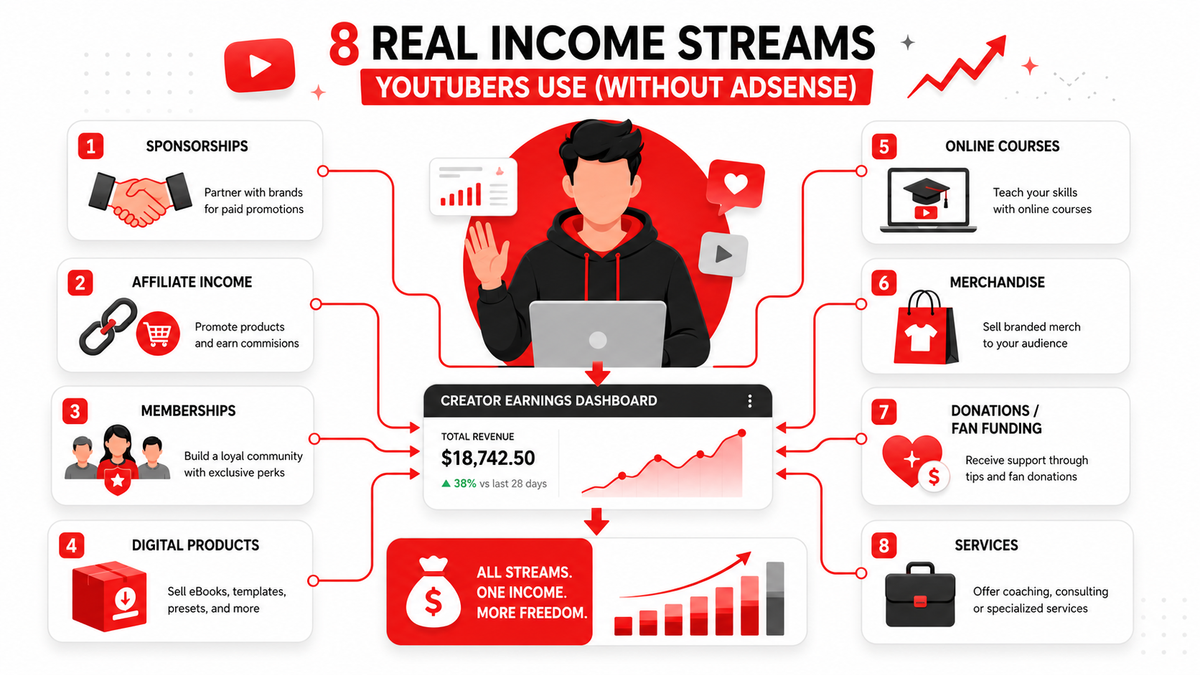
AdSense is one stream, and for most channels it is not the most profitable one. Here are eight real income streams that do not depend on ad rates — and which ones you can start before you are monetized.
AdSense gets all the attention, but it is rarely the reason a channel becomes a real business. Across channels between 100,000 and 1 million subscribers, ads typically account for only about 38% of total income — the rest comes from sponsorships, affiliate links, memberships, fan funding, digital products, services, shopping, and licensing. That stat reframes the entire conversation. If you are waiting for the monetization threshold before you start earning, you are leaving the majority of the money on the table. This article walks through eight income streams that do not depend on the ad rate the market happens to give you, what each one requires, what it can realistically pay, and how to combine them into a mix that survives slow seasons.
Introduction
For most new creators, making money on YouTube means the same three letters: YPP. Get monetized, turn on ads, watch the balance grow. It is a natural assumption, and a limiting one. Ad revenue is the most volatile and lowest-margin stream you will ever run, and it sits behind the 1,000-subscriber gate before it pays a cent. The channels that actually earn a living on this platform treat ads as one small stream among many. This guide breaks down eight ways to make money without relying on AdSense, the effort each one takes, the income each can realistically produce, and which streams you can start before you are monetized at all.
Why Diversifying Beyond AdSense Matters
Three reasons stand out. First, ad revenue is outside your control in ways that hurt. Advertiser demand swings with the economy, the fourth quarter pays better than the first, mid-roll placement changes the math, and a single demonetization strike can cut a month's revenue toward zero. RPM ranges from under $3 for gaming and entertainment to $8 to $20 or more for finance, tech, and education — a gap you cannot close by working harder, only by changing niche or audience. Second, ad revenue is inefficient. A sponsorship sells your last 90 days of views at a CPM you negotiate; an affiliate link converts the same audience into a percentage of a sale; a product sale keeps the full margin. Every non-ad dollar is worth more than an ad dollar because you set the price instead of accepting whatever the auction clears. Third, and most practical for new channels: several of these streams have no subscriber minimum and no YPP requirement at all. Services, affiliate marketing, digital products, and UGC work can produce income from your very first upload. Diversification is not a luxury strategy for big channels — it is the fastest path for small ones.
Stream 1: Brand Sponsorships
Sponsorships are the highest-paying single stream for most mid-size channels, and the math is consistent. The formula brands actually use is simple: take your average views over the last 90 days, divide by 1,000, and multiply by your niche's CPM. That produces ranges that scale with channel size — roughly $50 to $500 per video for channels between 1K and 10K subscribers, $500 to $5,000 between 10K and 100K, $2,000 to $20,000 between 100K and 1M, and $20,000 and up beyond a million. Sponsored Shorts pay a much lower CPM, typically $5 to $15. The catch is that sponsorships reward consistency, not virality. Brands buy your last 90 days of views, so a channel that uploads weekly and holds a steady engagement rate of 4% to 8% is dramatically easier to sell than one that spiked once and went quiet. The Thumbix Sponsorship Calculator turns your real 90-day average views and niche into a defensible rate, and the Brand Deal Calculator helps you package dedicated videos, integrations, and Shorts spots into tiers. The numbers are estimates and never guaranteed, but the formula is the same one brands use when they open your rate card.
Stream 2: Affiliate Marketing
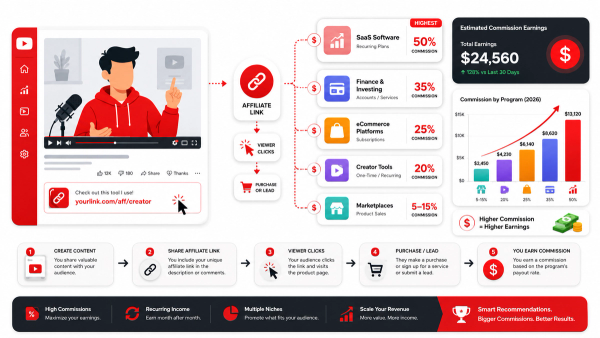
Affiliate income is the closest thing YouTube has to passive money. You recommend a product, share a tracked link in your description, and earn a commission when a viewer buys. The commission structure matters far more than the brand name. SaaS and software programs commonly pay 20% to 65% and are often recurring — you keep earning while the customer stays subscribed. Finance programs frequently pay $50 to $200 per approved lead. Shopify pays roughly $150 flat per qualified referral. Amazon's storefront, by contrast, pays only about 3% to 4.5% with a tight 24-hour cookie. Most affiliate programs have no subscriber minimum whatsoever. What the stream actually costs you is trust. The FTC requires you to disclose affiliate relationships in your description, and viewers can smell a recommendation that exists only for commission. The creators who make real affiliate income recommend products they would defend in the comments, test them when they can, and tell the truth when something is a compromise. Affiliate income rewards niche authority and audience trust, which is precisely what a well-run channel is built to produce.
Stream 3: Channel Memberships
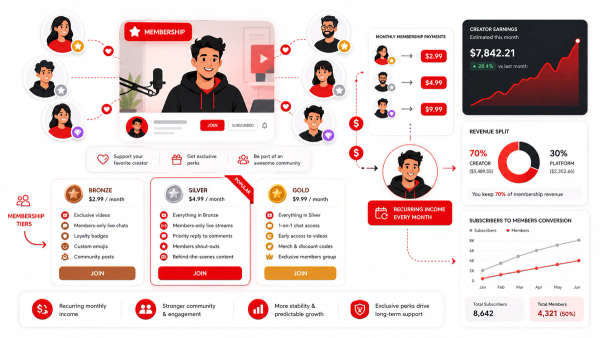
Memberships let viewers pay a recurring monthly fee in exchange for badges, custom emojis, and exclusive perks. You keep about 70% of the fee — a $4.99 tier nets roughly $3.49 per member per month — and iOS purchases cost you another roughly 30% in Apple's cut, so steer mobile users toward the web when you can. Typical conversion runs 0.5% to 2% of subscribers, with educational and tutorial channels converting two to three times better. On a 100K-subscriber channel with a 1% conversion and a $5 average tier, that is roughly $5,000 a month before platform fees. Memberships require YPP approval, but the early-access tier at 500 subscribers and 3 public uploads in 90 days unlocks them along with the rest of fan funding. The people who join are not paying for content they cannot get anywhere else; they are paying to belong. Perks that create belonging — member-only community posts, behind-the-scenes footage, monthly Q and A, early access — convert far better than perks that just unlock a discount.
Stream 4: Super Thanks and Super Chat
Fan funding is YouTube's built-in tipping system, and it is the purest example of the audience paying you directly. Super Thanks are $2 to $50 one-time tips attached to any upload, with a 70% keep rate. Super Chat runs $1 to $500 during live streams and pins the tipper's message in colored text; Super Stickers are the lightweight live option. All three are available on the early-access YPP tier, not just full monetization. Be realistic about expectations here. Tips are a small but genuine stream that flows when the community is warm, when live-streamers read names on air and thank people personally, and when milestones and launches give people an occasion to give. They rarely replace a salary on their own. But they convert loyal viewers into repeat supporters, they never depend on ad rates, and on a channel with an engaged niche they quietly add hundreds of dollars a month.
Stream 5: Selling Digital Products
Digital products are where creator income stops being a share of someone else's budget and becomes real margin. Ebooks, templates, presets, spreadsheets, planners, and mini-courses sell for the price you set, with no platform cut eating into the sale. YouTube functions as a free storefront: every video is content marketing aimed at a problem your product solves, and every viewer is a potential customer who already trusts you. The economics are attractive, but the work is upfront — building something people will actually pay for. The playbook that works is validation before production. Offer the product to your existing audience at a pre-sale price before you build it; if nobody bites at a discount, they will not bite at full price. Then build the thing people ask for, not the thing you want to make. Digital products have no YPP requirement and no subscriber minimum. You can sell from your first upload, which makes this one of the few streams where a brand-new channel and a million-subscriber channel compete on equal footing.
Stream 6: Selling Services
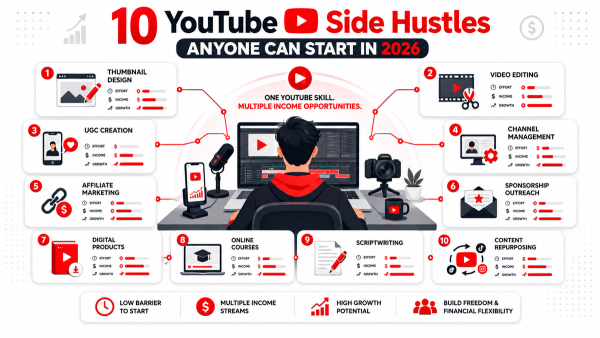
Your channel is living proof that you can do something — edit, script, design thumbnails, run a community, manage an account, produce short-form video. Services convert that proof into cash, and they are typically the fastest first dollar a new creator earns, because you are selling your time and skill rather than an audience you have not built yet. Channel management retainers, thumbnail design, editing packages, and UGC creation are all services small channels sell surprisingly well. Rates vary wildly, and the honest answer is that your early service work underprices you. That is fine — the point of the first few jobs is the portfolio and the testimonials, not the check. Every service client is also a case study you can show the next prospect. For creators who want a business that does not depend on algorithms, services are the most reliable bridge from hobby to income.
Stream 7: YouTube Shopping
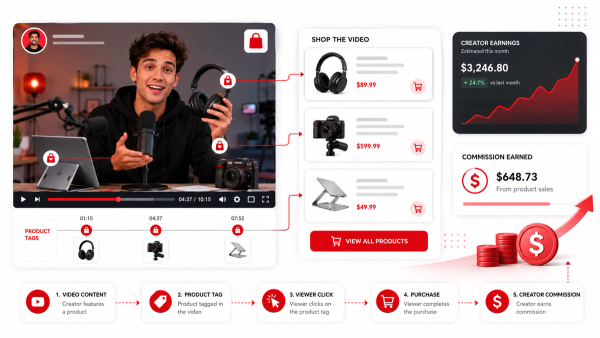
YouTube Shopping lets you tag products directly in videos, Shorts, and live streams with a shopping-bag icon, so viewers can buy without leaving the platform. The affiliate commissions vary by category: beauty pays 8% to 18%, fashion 6% to 15%, electronics 2% to 6%, home 5% to 12%, and fitness 8% to 15%, with cookies lasting 24 to 72 hours. Eligibility requires YPP approval plus a subscriber threshold that has changed over time and varies by region, so check the current YouTube Help before building a plan around it. This is a strong stream for product-centric niches, where every video doubles as a storefront and tagging a product at the moment you mention it is no harder than adding a timestamp. For review channels, tutorial channels, and any creator whose content is fundamentally about things viewers buy, Shopping can quietly become one of the larger streams in the mix.
Stream 8: Licensing and UGC Work
The final stream sells your content and your skills outside the channel itself. Licensing raw footage or short clips to media outlets, stock platforms, and other brands turns your camera and editing workflow into billable assets. Paid UGC — user-generated content created for brands to run in their own ads and social feeds — has exploded precisely because advertisers want authentic creators, not just big channels. A single UGC video can pay anywhere from $50 to several hundred dollars depending on usage rights. UGC work is especially appealing to small channels because it does not require an audience at all. Brands are buying your ability to sound like a real person on camera, your lighting, and your editing. You can start pitching brands the day you upload your first video, and the work doubles as portfolio material for your channel.
The 8 Streams at a Glance
- Brand sponsorships: Medium — pitching plus delivery, $50 to $20,000+ per deal, Any size, needs steady 90-day views
- Affiliate marketing: Low after setup, 20% to 65% on software; $50+ per finance lead, Any size, no minimum
- Channel memberships: Medium — exclusive perks, ~$3.49 net per member at $4.99 tier, YPP approval required
- Super Thanks / Super Chat: Low, 70% of tips, $2 to $500 each, YPP (early-access tier ok)
- Digital products: High upfront, then low, Full margin, you set the price, Any size, no minimum
- Services: High — you are the product, Time-based, fastest first dollar, Any size
- YouTube Shopping: Medium — tagging and setup, 2% to 18% by category, YPP plus region-dependent threshold
- Licensing / UGC: Medium, $50 to several hundred per asset, Any size, no audience needed
The table is a snapshot, not a promise. The income potential column is a range of real outcomes from 2026 channels, and every number here is an estimate. Effort is relative to your existing skills, and 'when it kicks in' is the realistic gate, not a guarantee that money will arrive.
Which Streams Need YPP and Which Do Not
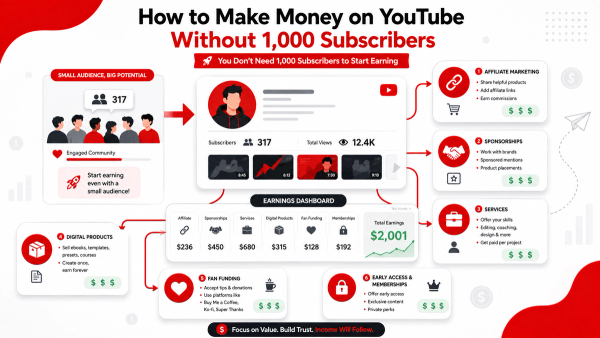
Precision here changes your roadmap, so get it right. Memberships, Super Thanks, Super Chat, Super Stickers, and YouTube Shopping all require YPP approval — though the early-access tier at 500 subscribers unlocks the fan-funding features without unlocking ads. Sponsorships, affiliate marketing, digital products, services, and licensing or UGC work have no YPP requirement and no subscriber minimum. For a brand-new channel, that means your first income realistically comes from services, affiliates, and small sponsorships, while memberships and shopping wait for the YPP gate. This is good news disguised as a limitation. The streams that need YPP are also the ones that compound once you have an audience and platform trust. Start the no-gate streams immediately, let them fund your growth, and treat YPP approval as the switch that turns on the second half of the toolkit. If you want the full breakdown of what you can do before you hit 1,000 subscribers, our guide to making money on YouTube without 1,000 subscribers covers the pre-monetization playbook in detail.
How to Build Your Own Mix
There is no universal mix, but the pattern that reliably works pairs one high-ticket stream with one reliable base. Services or sponsorships carry the high-ticket end; affiliate links and memberships supply recurring base income; fan funding rides along as a community bonus. Choose streams that fit your niche — a finance channel leans on affiliates and courses, a beauty channel leans on shopping and sponsorships, a tutorial channel leans on memberships and digital products. Whatever you pick, keep the numbers honest. Set a monthly income target and work backward: how many sponsorships, members, or sales does that require at your current rates? The Revenue Goal Calculator does exactly this arithmetic, turning a vague goal into a concrete monthly plan. These are estimates and nothing is guaranteed, but a plan with real targets is dramatically more likely to produce real income than a channel that simply hopes.
How can I make money on YouTube without AdSense?
Through eight streams: brand sponsorships, affiliate marketing, channel memberships, Super Thanks and Super Chat, digital products, services, YouTube Shopping, and licensing or UGC work. Most of them do not depend on ad revenue at all.
Do I need 1,000 subscribers to make money on YouTube?
Not for most non-ad streams. Services, affiliates, digital products, UGC, and small sponsorships have no subscriber minimum. Memberships, fan funding, and Shopping need YPP approval, which the early-access tier at 500 subscribers can unlock for fan funding.
Which YouTube income stream makes the most money?
Sponsorships usually pay the most per single deal at scale, but digital products and affiliate programs often generate the best margin. It depends entirely on your niche, audience, and consistency.
How do I price a sponsorship without AdSense?
Use the standard brand formula: average views over the last 90 days divided by 1,000, multiplied by your niche CPM. The Thumbix Sponsorship Calculator and Brand Deal Calculator handle the math for you.
Do memberships and Super Thanks require YPP?
Yes. All fan-funding features — memberships, Super Thanks, Super Chat, and Super Stickers — require YPP approval, but the early-access tier at 500 subscribers unlocks them without unlocking ad revenue.
Is affiliate marketing worth it on a small channel?
Yes, especially software and finance programs that pay 20% to 65% or $50 to $200 per lead. Small audiences convert well when trust is high, and there is no subscriber minimum.
What is the fastest way for a new channel to earn money?
Selling services or taking UGC work. Both pay for your skill rather than your audience, so they work from the first upload, and they double as portfolio material.
Can I sell products through YouTube Shopping without YPP?
No. YouTube Shopping requires YPP approval plus a subscriber threshold that has shifted over time and varies by region. Check the current YouTube Help guidance before planning around it.
Final Takeaway
AdSense is one stream, and for most channels it is not the most profitable one. The creators making real money on YouTube sell attention, trust, and skill across eight pipes: sponsorships, affiliates, memberships, fan funding, products, services, shopping, and licensing. And the most encouraging part is that most of these streams do not even require monetization. Pick two that fit your niche, price them honestly with a calculator, and turn the channel into a business instead of a view counter. Start before you are monetized, and by the time YPP approves you, the income will already be flowing.
Frequently Asked Questions
How can I make money on YouTube without AdSense?
Through eight streams: brand sponsorships, affiliate marketing, channel memberships, Super Thanks and Super Chat, digital products, services, YouTube Shopping, and licensing or UGC work. Most do not depend on ad revenue at all.
Do I need 1,000 subscribers to make money on YouTube?
Not for most non-ad streams. Services, affiliates, digital products, UGC, and small sponsorships have no subscriber minimum. Memberships, fan funding, and Shopping need YPP approval, which the early-access tier at 500 subscribers can unlock for fan funding.
Which YouTube income stream makes the most money?
Sponsorships usually pay the most per single deal at scale, but digital products and affiliate programs often generate the best margin. It depends on your niche, audience, and consistency.
How do I price a sponsorship without AdSense?
Use the standard brand formula: average views over the last 90 days divided by 1,000, multiplied by your niche CPM. The Thumbix Sponsorship Calculator and Brand Deal Calculator handle the math.
Do memberships and Super Thanks require YPP?
Yes. All fan-funding features require YPP approval, but the early-access tier at 500 subscribers unlocks them without unlocking ad revenue.
Is affiliate marketing worth it on a small channel?
Yes, especially software and finance programs that pay 20% to 65% or $50 to $200 per lead. Small audiences convert well when trust is high, and there is no subscriber minimum.
What is the fastest way for a new channel to earn money?
Selling services or taking UGC work. Both pay for your skill rather than your audience, so they work from the first upload and double as portfolio material.
Can I sell products through YouTube Shopping without YPP?
No. YouTube Shopping requires YPP approval plus a subscriber threshold that has shifted over time and varies by region. Check the current YouTube Help guidance.