Table of Contents
- Introduction
- Why YouTube Is the Perfect Top of Funnel
- The Funnel: From View to Sale
- Building Your Lead Magnet
- Validating Demand Before You Build
- Pricing Your Course
- The Launch Video Sequence
- Conversion Math: Views to Emails to Sales
- Beyond the Launch: Evergreen Sales
- Using the Revenue Goal Calculator
- Frequently Asked Questions
- Final Takeaway
A course sold through YouTube is a funnel, not a pitch. Videos feed lead magnets, lead magnets feed an email list, and the list feeds sales — here is the whole system with real conversion math.
Selling a course on YouTube is not about adding a link to your description and hoping. It is a funnel with four distinct stages — a viewer sees a video that promises an outcome, trades their email for a lead magnet that delivers a preview of that outcome, and eventually pays for the complete path to it. Each stage has a conversion rate, and when you know those rates, course sales stop being luck and start being arithmetic. This guide walks through the whole system: the funnel structure, the lead magnet, demand validation before you spend months building, pricing, the launch sequence, the conversion math, and how to keep sales flowing after launch day.
Introduction
An online course is the highest-margin product a YouTube creator can sell: full price, no platform cut, built once and sold repeatedly. The catch is that a course only sells to people who already know, like, and trust you — which is exactly what a channel builds over time. YouTube gives you free reach, a pre-warmed audience, and a content library that doubles as course marketing. This guide treats course selling as a system rather than a one-off promotion, covering the funnel, the lead magnet, validation, pricing, the launch sequence, the conversion numbers, and the tools that turn a revenue goal into a required view count.
Why YouTube Is the Perfect Top of Funnel
A course funnel needs three things: traffic, trust, and a list. YouTube provides all three better than almost any channel available. Every video you publish is a piece of content marketing aimed at the exact problem your course solves, and search brings people who are actively looking for that problem's solution — the highest-intent traffic on the internet. The trust component is built-in: someone who has watched a dozen of your videos already treats you as an expert, which is a head start no ad campaign can buy. And the traffic is free, which matters because course funnels are measured in conversions, not impressions. The strategic move is to let YouTube do what it does best — attract and educate a large audience — while you build your business where you own the relationship: your email list. The platform's algorithm owes you nothing; an email list is the only audience you cannot lose.
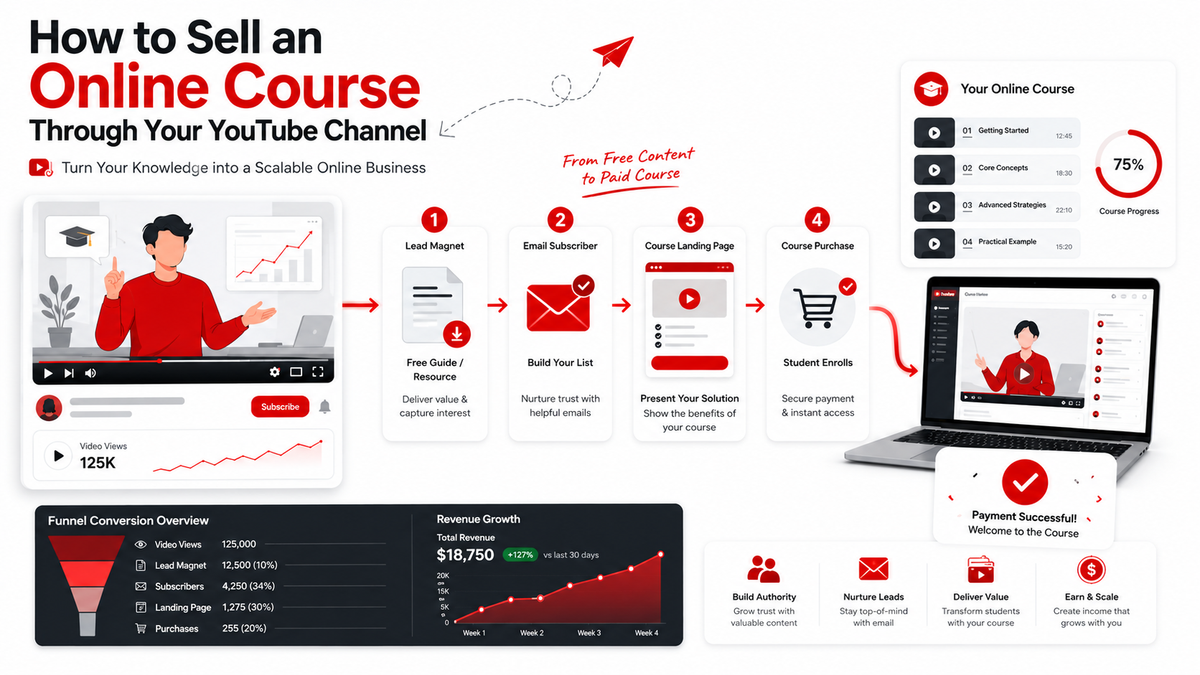
The Funnel: From View to Sale
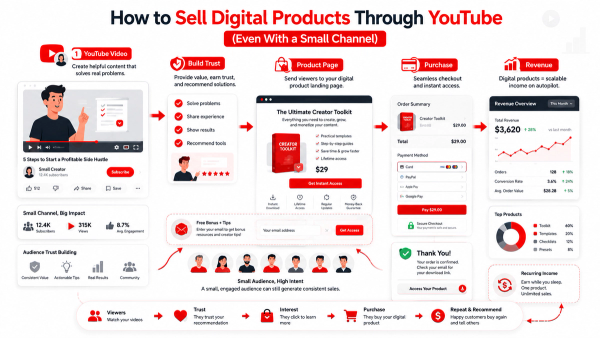
The funnel has four stages, and each has its own job and its own conversion rate.
- View: a viewer watches a video that promises an outcome you can teach.
- Lead magnet: at the end of that video, they trade their email for a free resource that delivers a small version of the outcome.
- Email sequence: a series of messages that delivers the free value, builds trust, and introduces the course as the complete solution.
- Sale: a paid landing page turns the interested subscriber into a customer.
The mistake most creators make is skipping the middle two stages and putting a course link directly in the description. That works only for the most trusted, most engaged audiences. For everyone else, a course link is just an ad. The lead magnet and email sequence are what warm cold traffic into buyers.
Building Your Lead Magnet
A lead magnet is a free resource that is valuable enough to trade for an email address and small enough to deliver immediately. Good lead magnets for course creators include a checklist, a template, a cheat sheet, a workbook, or a mini-video course. The essential quality is that it previews the outcome of the full course: someone who uses your checklist gets a taste of the transformation your course provides, and the desire to go deeper becomes the reason they buy. The offer that converts best is specific and instantly useful. A 'YouTube optimization checklist' outperforms a generic 'guide to growing your channel'. Deliver it automatically — an email or a landing page — and make the signup form a single field so nothing stands between the viewer and the download. The lead magnet is the first real promise you make to a stranger; make it good.
Validating Demand Before You Build
Validation is the step that separates creators with course businesses from creators with half-built courses nobody buys. Before you spend months producing lessons, confirm that people will pay. Three cheap signals: search volume on the topics your course would cover, engagement on your own videos about those topics, and direct requests from viewers asking for exactly that product. If people already ask 'how do you do X?' in your comments, that is demand knocking. The strongest validation is a pre-sale. Offer the course at a founding-member discount before you build it, with a clear delivery date, and let the number of pre-sales tell you whether the idea has legs. If the pre-sale underperforms, you have spent an afternoon instead of three months. If it sells out, you have a funded course and a warm launch list. Build after the proof, not before.
Pricing Your Course
Course pricing is a range, not a single answer, but the logic is consistent: price against the value of the outcome, not the cost of production. A course that saves someone $500 a month can justify a price in the hundreds; a course that saves someone a Sunday afternoon cannot. In 2026, a practical benchmark for a solo-creator course is $100 to $500 for a complete program, with higher tiers — community access, live Q and A, feedback — priced accordingly. Free-to-$50 price points attract tire-kickers and rarely fund a real business; premium pricing filters for people who will actually do the work. The emotional math matters too. A $197 course feels easier to justify than $200, and a three-payment plan of $67 feels safer than a single $197 charge. Test pricing at launch and adjust with real data rather than opinion.
The Launch Video Sequence
A launch is not one video; it is a sequence that walks the audience through a problem, a promise, and a solution. A structure that works for course creators:
- Teaser video: a week before launch, tease the transformation the course delivers without showing the product.
- Problem video: the pain your course solves, told through a real story or demonstration.
- Free value video: deliver a genuinely useful lesson for free — the audience feels the teaching quality.
- The launch video: introduce the course, show the curriculum, share the founding-member price, and state the deadline.
- Follow-up video: one or two days before the deadline, answer objections and remind viewers the founding price ends.
During launch week, every video you publish funnels to the same offer, and every live stream ends with a gentle pointer. The deadline creates urgency; the free lesson creates proof. The sequence works because it earns attention before it asks for money.
Conversion Math: Views to Emails to Sales
Here is where the funnel becomes a spreadsheet. Typical 2026 ranges for a solo creator course funnel, all estimates: 1% to 5% of viewers click through to a lead magnet, 30% to 60% of those who land on the signup form complete it, and 2% to 5% of the email list buys during a launch. The compounding effect of three conversion rates means you need a lot of views at the top.
- Views: 100%, 100,000
- Lead magnet signups: 2% of views, 2,000 emails
- Email completion: 80% of clicks, 1,600 added
- Launch buyers: 3% of list, 48 sales
At a $197 course price, 48 sales is roughly $9,400 from a single launch — and those 1,600 emails remain an asset for every future launch, affiliate promotion, and product. The same 100K views with a 5% signup rate and a 5% buy rate produce over 250 sales. The lever that matters most is the click-through to the lead magnet, because improving the top of the funnel multiplies every stage below it.
Beyond the Launch: Evergreen Sales
The launch is the loudest moment, but it should not be the only one. Evergreen sales — course links that quietly convert from search-driven videos all year — are what turn a course into recurring income. Every video about the topic your course covers should carry a soft link or mention, and your email list should receive a gentle reminder of the course at a cadence that respects them, not a cadence that annoys them. Webinar-based launches two or three times a year outperform constant promotion, and they give the funnel a reason to stay alive. The consistent engine is the content itself. Search traffic for 'how to solve problem X' lands on your video, the video points to the lead magnet, and the sequence does the selling while you sleep. Build the funnel once, feed it with weekly videos, and let evergreen sales compound with the algorithm's favor.
Using the Revenue Goal Calculator
Course selling is the clearest place on YouTube to plan backward from a revenue goal. Say you want a launch to produce $10,000. At a $197 price, that is roughly 51 sales. At a 3% launch conversion, that needs about 1,700 active subscribers on your email list, which at a 2% signup rate needs about 85,000 views on your funnel videos. The Thumbix Revenue Goal Calculator runs this exact arithmetic in seconds: enter the revenue target, the price, and your estimated conversion rates, and it returns the views required at the top of the funnel. The YouTube Money Calculator adds the ad-revenue perspective so you can compare what those same views earn passively. The numbers are estimates — but a goal with a required view count is far more likely to happen than a goal with a wish attached.
How do I sell a course through YouTube?
Build a funnel: videos attract viewers, a lead magnet captures their email, an email sequence builds trust, and a sales page closes the sale. Do not rely on a description link alone.
Do I need many subscribers to sell a course?
No — you need engaged viewers and an email list. A small, loyal audience converts better than a large, passive one. A few thousand engaged subscribers can outsell a hundred thousand lukewarm ones.
What is a good price for an online course?
For a solo creator, $100 to $500 is a realistic 2026 range for a complete program, priced against the value of the outcome rather than the cost of production. Higher tiers add community and feedback.
How do I validate demand before building?
Check search volume and your own video engagement on the topic, note viewers asking for the product in comments, and run a founding-member pre-sale before you build.
What is a lead magnet and why do I need one?
A lead magnet is a free, instantly useful resource — checklist, template, mini-lesson — that viewers trade their email for. It is the bridge between casual viewing and buying.
How many views do I need to sell a course?
At typical conversion rates, 100,000 views might produce around 40 to 50 sales at a $197 price. The view count you need depends entirely on your signup and email conversion rates.
Should I make a free course first?
A free mini-course or lead magnet that previews the paid course is a proven warm-up strategy. The free content demonstrates teaching quality and fills the funnel with proven buyers.
How do I promote my course without being spammy?
Mention it where it naturally solves a problem, run launches in focused bursts with a deadline, and let the email sequence do the persistent selling. Never pitch in every video.
Final Takeaway
A course is the highest-margin product most creators will ever sell, and YouTube is the free engine that fuels it. Treat the channel as the top of a funnel, capture emails with a genuinely useful lead magnet, validate demand before you build, price against outcome, and launch with a sequence that earns attention first. The conversion math is real and modest — a few percent at each stage — which is exactly why the funnel structure matters. Work backward from your revenue goal to the views required, and let weekly videos keep the engine running all year.
Frequently Asked Questions
How do I sell a course through YouTube?
Build a funnel: videos attract viewers, a lead magnet captures their email, an email sequence builds trust, and a sales page closes the sale. Do not rely on a description link alone.
Do I need many subscribers to sell a course?
No — you need engaged viewers and an email list. A small, loyal audience converts better than a large, passive one. A few thousand engaged subscribers can outsell a hundred thousand lukewarm ones.
What is a good price for an online course?
For a solo creator, $100 to $500 is a realistic 2026 range for a complete program, priced against the value of the outcome rather than the cost of production. Higher tiers add community and feedback.
How do I validate demand before building?
Check search volume and your own video engagement on the topic, note viewers asking for the product in comments, and run a founding-member pre-sale before you build.
What is a lead magnet and why do I need one?
A lead magnet is a free, instantly useful resource — checklist, template, mini-lesson — that viewers trade their email for. It is the bridge between casual viewing and buying.
How many views do I need to sell a course?
At typical conversion rates, 100,000 views might produce around 40 to 50 sales at a $197 price. The view count you need depends on your signup and email conversion rates.
Should I make a free course first?
A free mini-course or lead magnet that previews the paid course is a proven warm-up strategy. The free content demonstrates teaching quality and fills the funnel with proven buyers.
How do I promote my course without being spammy?
Mention it where it naturally solves a problem, run launches in focused bursts with a deadline, and let the email sequence do the persistent selling. Never pitch in every video.