
Table of Contents
The first affiliate sale is closer than it looks. Pick a program with no subscriber minimum, disclose honestly, place links where viewers actually look, and the numbers stop being abstract.
Every creator remembers the first affiliate sale differently: a notification at midnight, a commission for a product you recommended in a video months ago, and the sudden realization that one video can keep earning. The path to that first sale is more mechanical than most people expect. It is not about viral reach or a huge subscriber count. It is about picking a program that pays you without a subscriber minimum, recommending products your small audience actually wants, disclosing the relationship honestly, and placing links where viewers will click them. This guide walks through the whole loop with realistic 2026 numbers.
Introduction
Affiliate marketing is the quiet income stream of the creator economy: you earn a commission when someone buys through your link, you usually earn it without any YPP requirement, and — critically for beginners — the video keeps selling long after upload day. This guide covers why affiliate marketing fits a brand-new channel so well, how to choose programs that actually pay beginners, the FTC disclosure rule you cannot skip, where links perform best, and how to convert your view count into a realistic income target using real conversion math. By the end you will know exactly what your first 1,000 views should be capable of producing.
Why Affiliate Marketing Suits New Channels
The number one reason affiliate marketing works for beginners: most programs have no subscriber minimum. Amazon Associates, Etsy, and thousands of software and product programs accept channels of any size. You do not need the 500-subscriber early-access tier, let alone the full 1,000-subscriber threshold. You need an audience of any size and a recommendation they trust. The second reason is compounding. Affiliate links live in descriptions and pinned comments forever. A video that earns $0 in week one can produce its first sale in month three, when a viewer finds it through search. Beginners massively underestimate how much of affiliate income is back catalog — most months, the majority of your sales will come from videos you published long ago. The third reason is control. Affiliate income does not depend on ad RPM, audience geography, or the YouTube algorithm's mood. It depends on one thing you can actually influence: whether your viewer buys what you recommend.
Choosing Affiliate Programs
The commission structure determines what is worth your time. The three tiers to know:
- Amazon Associates: 1% to 10% per sale, typically 3% to 4.5%, with a 24-hour cookie. Huge catalog, low rates. Best for products under $50 that people buy on impulse.
- Etsy: 4% to 8% with a 30-day cookie. Great for craft, stationery, and small-business niches.
- SaaS and digital: 20% to 65%, often recurring on the subscription. Finance affiliate programs commonly pay $50 to $200 per approved lead or account. This is where the real money is.
The rule for beginners: prioritize digital and SaaS programs in your niche, because a 30% recurring commission beats a 4% one-time commission no matter how many views you get. Physical products are fine for supplementary income, but software is what makes a small channel's affiliate income meaningful. YouTube Shopping also offers its own affiliate program, but note the eligibility: it requires the YPP and a subscriber threshold that has shifted over time and is region-limited. Check the current YouTube Help eligibility before you build your strategy around it. The commission table only matters once the product fits your audience. The question to ask about every program candidate is not how much it pays but whether your viewers would buy it with a clear conscience. A finance channel recommending a budgeting app at 35% recurring commission converts because the product is the natural next step; the same channel pushing a gaming chair at 40% converts at zero because the audience does not want it. Shortlist programs by fit first, then rank by commission, then test with one video each. A small library of well-matched programs beats a huge library of mismatched links.
The FTC Disclosure Requirement
The Federal Trade Commission requires that you disclose affiliate relationships clearly and conspicuously — and YouTube's monetization policies reinforce it. A tiny 'affiliate link' buried at the bottom of a description does not reliably qualify as conspicuous, and the safest practice is to disclose in the video itself. A single sentence early in the script — 'Some links in this video are affiliate links, meaning I may earn a small commission if you buy' — costs you five seconds and protects you completely. The honest framing is also the better business move. Affiliate income runs on trust, and trust collapses the moment a viewer discovers you were hiding a paid relationship. Disclose early, disclose clearly, and recommend only what you genuinely use. Disclosed recommendations convert better than hidden ones, because the viewer's guard stays down.
Where to Place Your Links
Viewers do not read descriptions the way creators think they do, so placement matters as much as the product. The spots that perform, in rough order of effectiveness:
- Pinned comment: the most visible link on a video page and the first thing the comment section shows. Pin your best link or a short list of links here.
- Early in the description: the first two lines show up above the fold on mobile. Put your most relevant link in the first line.
- End screen: you can add clickable links to end screens on eligible videos. This is where viewers are most primed to act.
- In-video call-outs: say the link is in the description at the exact moment you recommend the product, and reinforce it once at the end.
- Cards: information cards can carry a single affiliate link, but some sponsorships restrict cards — keep your own videos carded, and check brand terms for sponsored ones.
Timing the in-video call-out also matters more than creators assume. The strongest moment is not when you mention the product — it is the beat after you have demonstrated the result, when the viewer's question has shifted from 'does this work' to 'where do I get it.' That is the moment to say the link is below, and it is the difference between a call-out that feels like an ad and one that feels like a solution. On longer videos, a second reminder near the end catches viewers who would otherwise close the tab and forget. One link per product moment is enough. Link-stuffing a description with ten affiliate links reads as desperate and tanks click-through. Give each video one hero recommendation and one or two support links.
Turning Views Into Affiliate Income
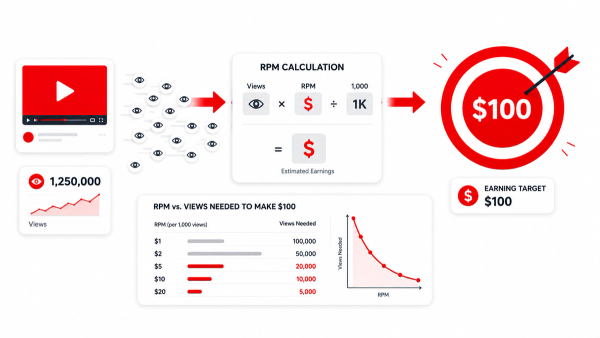
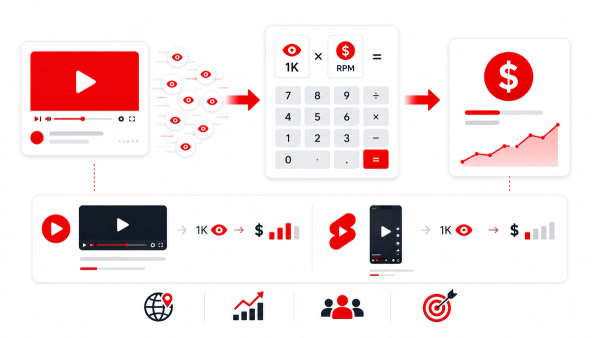
The chain is: views become clicks, clicks become sales. Realistic 2026 numbers for a small channel look like this: a well-placed link in the description and pinned comment typically clicks through at 1% to 3% of views. A strong conversion rate for an honest recommendation is 3% to 5% of those clicks. So a video with 5,000 views at a 2% click-through gives about 100 clicks, and a 4% conversion gives about four sales. Now multiply by commission. A $40 physical product on Amazon at 4% pays about $1.60 per sale — four sales is about $6. Not life-changing. A $29/month software product on a 30% recurring commission pays about $8.70 per sale, and the recurring ones keep paying as long as the subscriber stays. A finance program paying $100 per approved lead turns those four conversions into $400. The product and the program choice matter more than the views. The other lever beginners overlook is volume. A single video almost never pays for itself in its first week, but forty videos each producing a few clicks a month is a steady drip that compounds. Treat your first few months as building the asset, not cashing it in: every video you publish with a well-placed link is inventory, and affiliate income is the interest on that inventory. The creators who make affiliate income feel effortless are usually just the ones who published through the awkward phase. The Thumbix YouTube Money Calculator is the right tool for this reverse math: tell it how many views you expect and what commission structure you are selling, and it shows what each video needs to produce your target income. The answer is usually 'fewer views and better products than you thought.'
Setting a Realistic First-Month Target
Beginners over-commit to income and under-commit to videos. A realistic first month looks like this: publish four to eight honest review or tutorial videos, each aimed at a problem your product solves; place links in descriptions, pinned comments, and end screens; and expect the vast majority of the income to arrive in month two or three as the videos start ranking in search. A sane first-month target: your first sale. Not $500. One sale. The Thumbix Revenue Goal Calculator helps you work backwards — enter your desired first-month revenue, your expected views per video, a 1% to 3% click-through and 3% to 5% conversion assumption, and your average commission, and it tells you how many videos and views that target really requires. More often than not, the honest answer is 'a handful of videos and a few thousand views,' which suddenly makes the first month feel achievable. Decide how you will measure before the month starts. The three numbers to track are views per video, link click-through rate, and conversion rate — and each tells you what to fix next. Views below target means the packaging and topics need work. Clicks below 1% means the link placement or the product fit is weak. Clicks converting below 3% means the product or the pitch to it needs strengthening. One month of data on all three turns your second month from a guess into a plan, which is why beginners who track beat beginners who vibe.
Affiliate Income Math on a Small Channel
Let's model one full month on a small channel to make the math concrete. Say you publish eight videos, each averaging 2,500 views in its first thirty days — that is 20,000 views total. At a 2% click-through, that is 400 clicks. At a 4% conversion, that is 16 sales. If you sold $60 physical products on Amazon at 4%, you would earn roughly $38. If those same 16 sales were a $99 digital course with a 30% commission, you would earn roughly $475. If they were finance leads at $100 each, roughly $1,600. The same views, wildly different outcomes — entirely decided by program choice. That is the entire strategy for a beginner: pick the highest-commission program your niche honestly supports, recommend one hero product per video, place the links where viewers click, and let the back catalog compound. Your first sale will come faster than the spreadsheet predicts, because the first one only needs one viewer to act.
Final Takeaway
The first affiliate sale is not about luck or audience size — it is about three choices made in advance. Choose a program with no subscriber minimum and a commission worth chasing, recommend one hero product per video with an honest, early disclosure, and place the link where the viewer is most likely to act. Then let the videos compound. Set your first-month target to one sale, model the math with the Revenue Goal Calculator, and treat every video after that as inventory. The first sale feels like an accident, but it was a pipeline.
Frequently Asked Questions
Do I need 1,000 subscribers to do affiliate marketing on YouTube?
No. Most third-party affiliate programs have no subscriber minimum. Only YouTube Shopping's affiliate program requires YPP membership plus a subscriber threshold that has shifted over time and is region-limited.
What is the best affiliate program for a beginner?
SaaS and digital programs with 20% to 65% commissions, ideally recurring, in your niche. Amazon Associates and Etsy are easy to start but pay less per sale.
Where should I place affiliate links on YouTube?
Pinned comment, the first lines of the description, end screens, and a spoken call-out in the video at the moment you recommend the product.
How much can a beginner make with YouTube affiliate marketing?
Depends on views and commission. A 20,000-view month with a 2% click-through and 4% conversion makes roughly 16 sales — around $38 on Amazon rates or $475 or more on a 30% digital program.
Do I need to disclose affiliate links?
Yes. The FTC requires clear and conspicuous disclosure, and the safest practice is to state it in the video itself as well as in the description.
How long until I make my first affiliate sale?
A few weeks to a few months. Early videos get almost no clicks in week one; income typically arrives once videos start ranking in search and the back catalog compounds.
What is a good conversion rate for affiliate links?
1% to 3% of views clicking through and 3% to 5% of clicks converting are healthy realistic ranges for honest recommendations.
Can I use the YouTube Money Calculator for affiliate income?
Yes. Enter your expected views and commission structure to work backwards from an income target to the clicks and conversions you need.