Table of Contents
- The Two Types of YouTube Thumbnails
- Why Creators Use Face-Based Thumbnails
- The Psychology Behind Faces in Thumbnails
- Why Creators Choose Faceless Thumbnails
- Niche-by-Niche Breakdown
- When Face-Based Thumbnails Work Best
- When Faceless Designs Work Better
- Combining Faces and Objects
- How to A/B Test Your Thumbnail Strategy
- A Practical Decision Framework
- Frequently Asked Questions
Should your thumbnail show your face or let the subject speak for itself? The answer depends on your niche, your brand, and what your audience expects to see.
The debate over face thumbnails versus faceless thumbnails is one of the most common strategic questions in YouTube content creation. You'll find creators on both sides making strong arguments — and both sides have real evidence to back them up. The problem is that most of the advice circulating online picks a side and sticks to it, when the honest answer is considerably more nuanced.
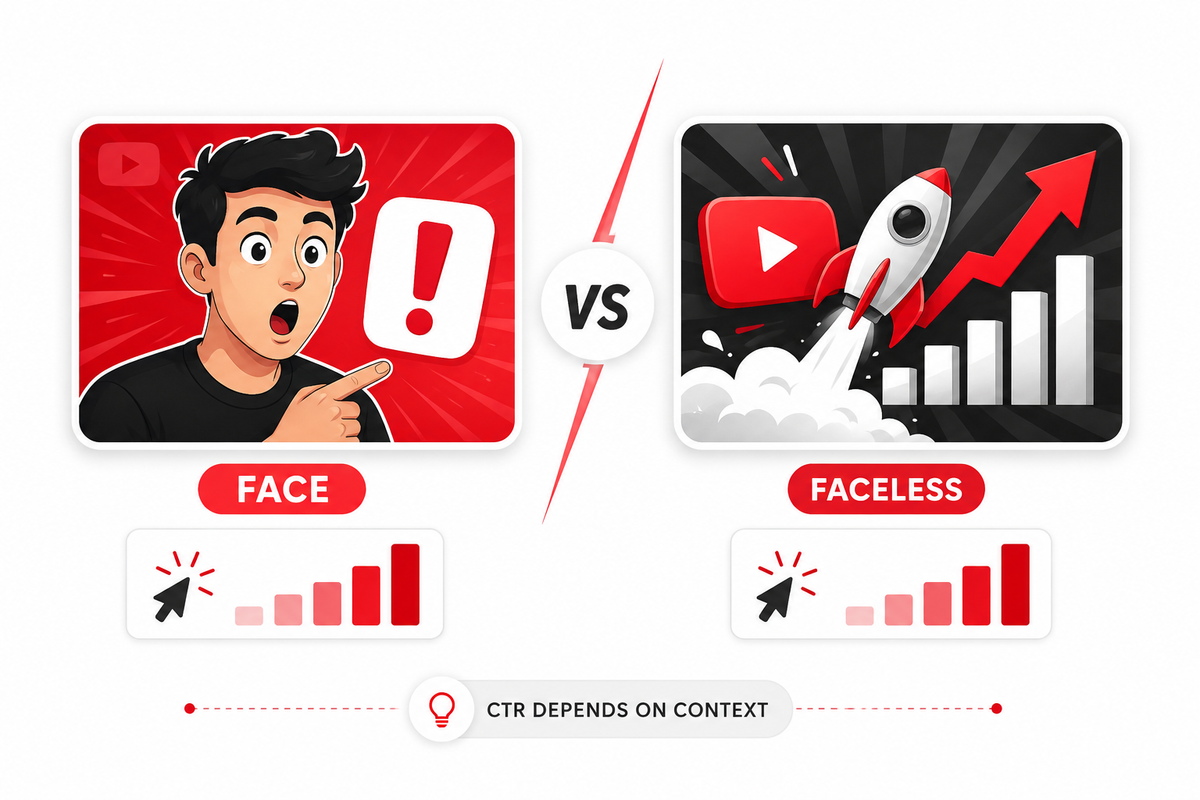
Faces do not universally increase click-through rate. Faceless thumbnails are not universally more professional or more clickable. What determines whether a face belongs in your thumbnail is a combination of your niche, your brand identity, the specific topic of the video, and what your particular audience has learned to expect from your channel.
This guide breaks down the actual decision-making process — with niche-specific analysis, psychological principles, and a practical A/B testing approach — so you can figure out which strategy works for your specific channel.
The Two Types of YouTube Thumbnails
A face-based thumbnail features a human face — typically the creator's own — as a primary or prominent element of the composition. The face usually displays a clear, readable emotion: surprise, excitement, skepticism, curiosity, or joy. The emotion is deliberate, calibrated to the emotional tone of the video.
A faceless thumbnail conveys the video's subject through imagery, graphics, text, product shots, stylized visuals, or a combination — without a human face as a central element. Faceless doesn't mean anonymous or low-effort; some of the most striking and effective thumbnails on YouTube feature no human face at all.
There's also a middle ground: thumbnails that include a face in a secondary role — present in the frame but not the focal point — where the primary visual subject is a product, result, or concept. This hybrid approach is worth considering and discussed later in this article.
Why Creators Use Face-Based Thumbnails
For many creators, especially those building a personal brand, showing their face in thumbnails is a deliberate identity-building strategy. When a viewer repeatedly sees the same face expressing genuine reactions, emotions, and personality, they begin to develop familiarity and trust with that creator. That familiarity influences future click decisions — not just on a single video, but across the channel's entire catalog.
For commentary, vlogging, reaction content, and opinion-led videos, the creator's face is often the content itself. The audience isn't just coming for the information — they're coming for that specific person's take on something. In this context, removing the face from the thumbnail would actually disconnect the visual packaging from the content.
Face-based thumbnails also leverage a powerful human instinct: we are biologically primed to notice and evaluate faces. Humans process facial expressions in fractions of a second. A striking facial expression can communicate an emotional tone — intrigue, alarm, delight — that no text or graphic can convey as quickly. In a fast-scrolling feed, that speed of emotional communication matters.
The Psychology Behind Faces in Thumbnails
Emotional Expressions
The specific expression matters enormously. A face wearing a blank neutral expression provides very little click motivation — it communicates nothing emotionally. An exaggerated expression of genuine surprise, disbelief, or excitement, on the other hand, creates an emotional gap in the viewer's mind: "What caused that reaction? I need to find out." That curiosity gap drives clicks.
However, there's an important caution here. Exaggerated expressions that feel manufactured or inauthentic — the stereotypical YouTuber "shocked face" meme — can signal low-quality, clickbait content to experienced viewers, particularly in niches like technology, finance, and education, where audiences often have high standards for production quality and intellectual rigor. What works brilliantly in gaming entertainment might actively damage credibility in a financial advice channel.
Eye Direction and Face Framing
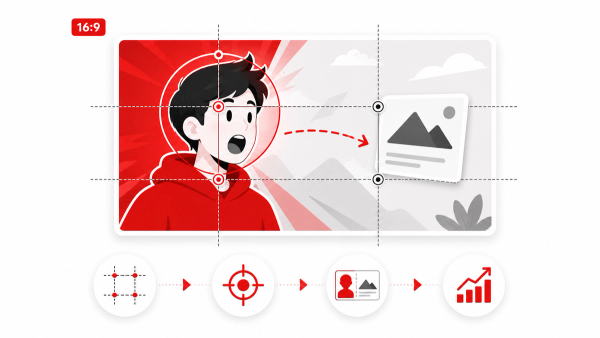
Research in visual attention has consistently shown that people instinctively follow the gaze of other people in images. If a face in a thumbnail is looking directly at the camera (and therefore at the viewer), it creates direct engagement. If the face is looking toward a specific element within the thumbnail — a product, a result, text — that gaze guides the viewer's eye toward the secondary focal point.
For thumbnails where both a face and a key visual element need to be present, placing the face so it looks toward the other element can help the viewer's eye move naturally through the composition. This is a classic technique used by professional thumbnail designers, and it works because it aligns with human visual instinct rather than fighting it.
Face Size and Subject Isolation
A face that occupies a large portion of the thumbnail frame is far more effective at generating emotional engagement than a small face tucked into the corner. If you're going to use your face, make it large enough to read clearly at small thumbnail sizes. Expressions become illegible at small sizes, which defeats the purpose entirely. A cropped face filling 40–60% of the frame typically performs better than a full-body shot where the face is a small fraction of the image.
Subject isolation also matters. A face against a cluttered background loses impact because the viewer's eye has too much competing visual information. Clean backgrounds, blurred backgrounds, or solid contrasting colors behind the face help isolate the subject and make expressions land more clearly.
Why Creators Choose Faceless Thumbnails
Faceless thumbnails are not a compromise made by creators who are camera-shy or anonymous by necessity. Many of the most successful YouTube channels in the world — including channels in technology, finance, cooking, history, documentary, and tutorial niches — consistently use faceless thumbnails as a deliberate creative choice.
The case for faceless thumbnails is simple: sometimes the subject is more compelling than the person presenting it. If you're reviewing a new piece of technology, a sharp image of that device against a clean background might tell the story more effectively than your face reacting to it. If you're posting a recipe video, an image of the finished dish is often more persuasive than a thumbnail of the chef.
Faceless thumbnails can also communicate authority and professionalism in certain contexts. In finance, law, medicine, and other serious subject-matter niches, a clean, designed thumbnail with a clear subject and minimal visual noise can signal that the content is credible, researched, and information-first — which is exactly what those audiences want.
Additionally, faceless thumbnails scale better for channels with large content libraries. Maintaining a consistent, recognizable visual identity using brand colors, typography, and layout is often easier without a face in every frame — and consistency across a channel's thumbnails is something audiences use to identify and trust a channel's content quickly.
Niche-by-Niche Breakdown
The best way to make the face vs. faceless decision is to look at what's actually working in your specific niche. The following breakdown offers strategic starting points — not universal rules. What works in one creator's channel may not work in another's, even within the same niche. Use this as a guide to inform testing, not as a definitive prescription.
| Niche | Face-Based Potential | Faceless Potential | What to Test First |
|---|---|---|---|
| Gaming | High — reactions and emotion drive clicks on reaction/commentary content | High — gameplay visuals work well for guides and walkthroughs | Expression + game visual vs. gameplay screenshot alone |
| Tutorials | Contextual — works when the creator's credibility is the draw | High — showing the result or process is often more compelling | Creator demonstrating vs. finished result or step graphic |
| Finance | Contextual — established experts can leverage identity | High — clean concept-driven thumbnails signal credibility | Expert + data visual vs. data visual alone |
| Commentary / Opinion | High — the creator's reaction is often the product itself | Contextual — works when the subject is visually striking | Creator emotion vs. subject graphic with text |
| Technology | Contextual — works for known personalities in tech | High — product and device photography is highly effective | Creator reacting to device vs. clean device shot |
| Education | Contextual — educator identity can build trust over time | High — concept visualizations and diagrams often perform well | Educator presence vs. visual concept illustration |
| Fitness | High — transformation and demonstration benefit from human presence | Contextual — works well for equipment reviews and plans | Person demonstrating exercise vs. workout plan graphic |
Every row in that table is a starting hypothesis, not a conclusion. The only way to confirm what works in your specific channel is to test it — which is covered in the A/B testing section below.
When Face-Based Thumbnails Work Best
Face-based thumbnails tend to perform best under these conditions:
- The creator is recognizable to their audience — returning subscribers are motivated by seeing the person they follow, not just the topic.
- Emotion is central to the video — the creator's reaction or opinion is the actual draw, not just a framing device.
- The expression is specific and legible — a clear emotion that creates a curiosity gap the viewer wants to resolve.
- The channel is personality-driven — the content is inseparable from the person presenting it.
- The niche audience expects and responds to personal, emotional content — gaming, commentary, vlogs, lifestyle.
When Faceless Designs Work Better
Faceless thumbnails tend to outperform face-based approaches in these situations:
- The subject itself is visually compelling — a beautiful dish, a striking product, a dramatic result, or a vivid concept illustration.
- The audience is information-seeking — viewers searching for tutorials, guides, or reference content want to see the answer, not the presenter.
- The channel is brand-based rather than personality-based — a business channel, a media brand, or an organization benefits from consistent visual identity over personal recognition.
- The creator is not yet recognizable — for newer channels, an unknown face provides less click motivation than a clear subject.
- The content is search-driven — viewers searching for specific information are often looking for the answer itself, and a thumbnail showing that answer can be more persuasive than a face.
Combining Faces and Objects
The face vs. faceless choice doesn't have to be binary. Many high-performing thumbnails combine a face with an object, result, or concept — using the face to provide emotional context while letting the subject carry the informational message.
For example, a tech review might show a creator looking at a product with an expression of genuine intrigue or skepticism — the product is the subject, the face provides the emotional framing. This approach gets the attention-grabbing benefits of a human face while keeping the informational subject prominent.
The key principle for combination thumbnails is visual hierarchy: one element must be the primary focal point, and the other must support it — not compete with it. A thumbnail that tries to give equal visual weight to a face and a product often ends up communicating neither clearly. Decide which element is the hero before composing the frame.
How to A/B Test Your Thumbnail Strategy
The only reliable way to know whether face-based or faceless thumbnails work better for your specific channel is to test it. The challenge is testing correctly — changing too many variables at once makes it impossible to identify what actually caused a change in performance.
Setting Up a Valid Test
The most reliable test compares two thumbnails on the same video — Version A (face-based) and Version B (faceless) — while keeping the title, topic, and video content identical. YouTube's built-in A/B testing feature (available for channels that have access to it in YouTube Studio) allows you to test thumbnails directly and see which version earns more clicks from the same pool of impressions.
If you test face vs. faceless across different videos with different topics, different titles, or different traffic conditions, you can't reliably attribute the CTR difference to the thumbnail alone. The topic, title, and traffic source all influence CTR independently — so controlling those variables is critical for any conclusion to be meaningful.
Variables to Control
- Keep the title identical across both thumbnail versions.
- Test on the same video — not two separate videos on similar topics.
- Allow enough time and impressions for statistically meaningful data — a test run on 500 impressions may not reflect true performance.
- Look at CTR in combination with average view duration — a higher-CTR thumbnail that leads to worse watch behavior may not be the better choice overall.
When YouTube's built-in thumbnail testing feature isn't available, you can approximate a test by launching a video with one thumbnail, tracking performance for a defined period, then switching to an alternative and monitoring for changes. This is less precise but still more informative than never testing at all.
A Practical Decision Framework
When deciding whether to use a face or go faceless for a specific video, work through these questions:
- Is my face (or another person's face) more compelling than the subject of this video? If the answer is clearly yes, use a face. If the subject is visually stronger, start with faceless.
- Does my channel have an established personal brand where my face is a recognized signal? If yes, a face-based thumbnail leverages that recognition. If you're newer, the face is less likely to be a draw.
- Does the emotional tone of the video benefit from a visible human reaction? Opinion and commentary content usually does. Tutorial and informational content often doesn't.
- What do the top-performing thumbnails in my niche look like? Checking competing thumbnails using a tool like Thumbix's thumbnail downloader can reveal the visual conventions your audience expects — and where there's space to differentiate.
- What does my historical channel data say? Check your own analytics to see whether your historically higher-CTR videos tend to have faces or not. Let the data guide you.
There's no permanent answer to the face vs. faceless question. Many successful channels use different approaches for different types of videos within the same channel — a face for opinion content, faceless for tutorials — because they've discovered through testing that their audience responds differently based on the content type.
The goal is to understand the principle: your thumbnail should make it immediately clear why this specific video is worth clicking. Sometimes a face communicates that most effectively. Sometimes a compelling subject image does. And sometimes the combination of both — done with a clear visual hierarchy — outperforms either alone.
One final note worth making explicit: regardless of whether you use a face or not, avoid thumbnails that misrepresent the emotional content of the video. A thumbnail showing shock and alarm for a video that is calm and informational is misleading — and viewers who feel deceived don't finish watching, which hurts your watch time signals and, over time, your channel's distribution.
Frequently Asked Questions
Do face thumbnails always get more clicks on YouTube?
No. Faces can be highly effective in personality-driven niches like commentary, gaming, and vlogs, but they don't universally outperform faceless designs. In information-first niches like tutorials, technology, and finance, a compelling subject image often outperforms a face thumbnail.
Should I put my face on my YouTube thumbnails if I'm a new creator?
For new creators, a face provides less click motivation because the audience doesn't yet recognize you. Leading with the subject — what the video is about — is often more effective until you've built name recognition. Test both approaches as your channel grows.
Can I run a successful faceless YouTube channel with faceless thumbnails?
Yes. Many of the most successful YouTube channels in finance, technology, education, and documentary content use consistently faceless thumbnails. A strong visual identity built around brand colors, typography, and subject photography can be just as recognizable as a face.
What expression should I use in a face thumbnail?
The expression should reflect the actual emotional tone of the video. A genuine expression of curiosity, surprise, or excitement is typically more effective than exaggerated performance. In some niches (finance, education), overly dramatic expressions can reduce perceived credibility.
How big should a face be in a YouTube thumbnail?
Large enough to be readable at small sizes. A face that occupies 40–60% of the frame typically communicates emotion more effectively than a full-body shot or a small face in the corner. The expression should be legible when the thumbnail is viewed at roughly 200px wide.
How do I test whether face or faceless thumbnails work better for my channel?
Use YouTube Studio's built-in thumbnail A/B testing feature if available on your channel. Create two versions of a thumbnail — one with a face, one without — for the same video, and compare CTR across both. Look at CTR alongside average view duration, not just click numbers alone.
Should the face in a thumbnail look at the camera or at a subject?
Direct camera eye contact creates a personal connection with the viewer. Looking toward a secondary element in the thumbnail guides the viewer's gaze toward that element. Both approaches work — the right choice depends on which element is the primary focal point of the thumbnail.
Do gaming channels need face thumbnails?
Not necessarily. Gaming thumbnails that feature strong gameplay visuals or character art can perform very well without a face. Some gaming channels use face overlays effectively; others use purely game-based imagery. The best approach depends on whether the channel is personality-driven or content-driven.