Table of Contents
- Is a YouTube Thumbnail Protected by Copyright?
- Who Generally Owns the Thumbnail?
- Can You Download Another Creator's Thumbnail?
- What Is Copyright Infringement?
- What Is Fair Use?
- The Four Fair-Use Factors
- Common Fair-Use Myths, Debunked
- Commentary, Criticism, and Reviews
- News Reporting
- Education
- Reaction Content
- Inspiration Versus Copying
- Using Screenshots and Thumbnails in Articles
- Using Thumbnails on Social Media
- Permission and Licensing
- Creative Commons Thumbnails
- A Practical Way to Think About Risk
- What to Do Before Reusing a Thumbnail
- If Your Own Thumbnail Has Been Copied
- Quick Decision Checklist
- Frequently Asked Questions
- Legal Disclaimer
Thinking of reusing someone else's YouTube thumbnail? Here's how copyright and fair use actually apply, and how to tell if your use is safe.
You found the perfect thumbnail for a reaction video. It's already sitting on the original creator's channel, it's already the right size, and re-uploading it would save you twenty minutes in Photoshop. Before you save that image and drop it into your own upload, it's worth understanding what you're actually allowed to do with it -- because "I could download it" and "I'm allowed to use it" are two very different questions.
This guide breaks down how copyright and fair use apply to YouTube thumbnails specifically, what the four fair-use factors actually mean in practice, and where creators most often get it wrong. It is written for creators, not lawyers, but it does not oversimplify the law -- because oversimplified copyright advice is how channels end up with claims, strikes, and takedowns.
Is a YouTube Thumbnail Protected by Copyright?
In most cases, yes. A custom thumbnail is a photograph, illustration, or composited image -- and under copyright law in the United States and most other countries, original visual works are protected automatically the moment they're created and fixed in a tangible form. No registration, watermark, or copyright notice is required for protection to exist, although registration does affect what remedies a creator can pursue if they sue.
There are edge cases. A thumbnail that is nothing more than an unedited frame grabbed directly from stock footage the creator doesn't own may carry weaker or shared rights. A thumbnail built entirely from public-domain elements might not be protectable on its own. But as a default assumption, treat every custom thumbnail you see on YouTube as copyrighted work belonging to someone.
Who Generally Owns the Thumbnail?
Ownership usually sits with whoever created the image, unless it was made as part of an employment agreement or under a contract that assigns rights elsewhere. If a creator designs their own thumbnail, they own it. If they hire a freelance thumbnail designer, ownership depends entirely on the contract -- many freelance agreements transfer rights to the client, but not all of them do automatically. If a channel is run by a team or agency, the channel owner typically holds the rights through employment or work-for-hire terms.
This matters because "the channel posted it" doesn't always tell you who actually owns the copyright. For everyday reuse questions, though, it's safe to treat the channel that published the video as the presumptive rights holder unless you have information suggesting otherwise.
Can You Download Another Creator's Thumbnail?
Technically, yes. Thumbnail images are publicly hosted, and tools -- including ones on this site -- let you save any thumbnail as a standalone image file. That technical ability exists for legitimate reasons: designers study competitor thumbnails for inspiration, journalists need images for coverage, researchers analyze visual trends, and creators reference their own back catalog.
But being able to download an image says nothing about whether you're allowed to republish it. This is the single most misunderstood point in thumbnail copyright, so it's worth stating plainly.
Being able to access an image is not the same as having permission to reuse it. Downloading is a technical action. Reuse is a legal one, and it's governed by copyright law, not by whether the file was easy to save.
Plenty of creators assume that if content is publicly visible on YouTube, it must be fair game to repost. That assumption doesn't hold up. Visibility is not a license.
What Is Copyright Infringement?
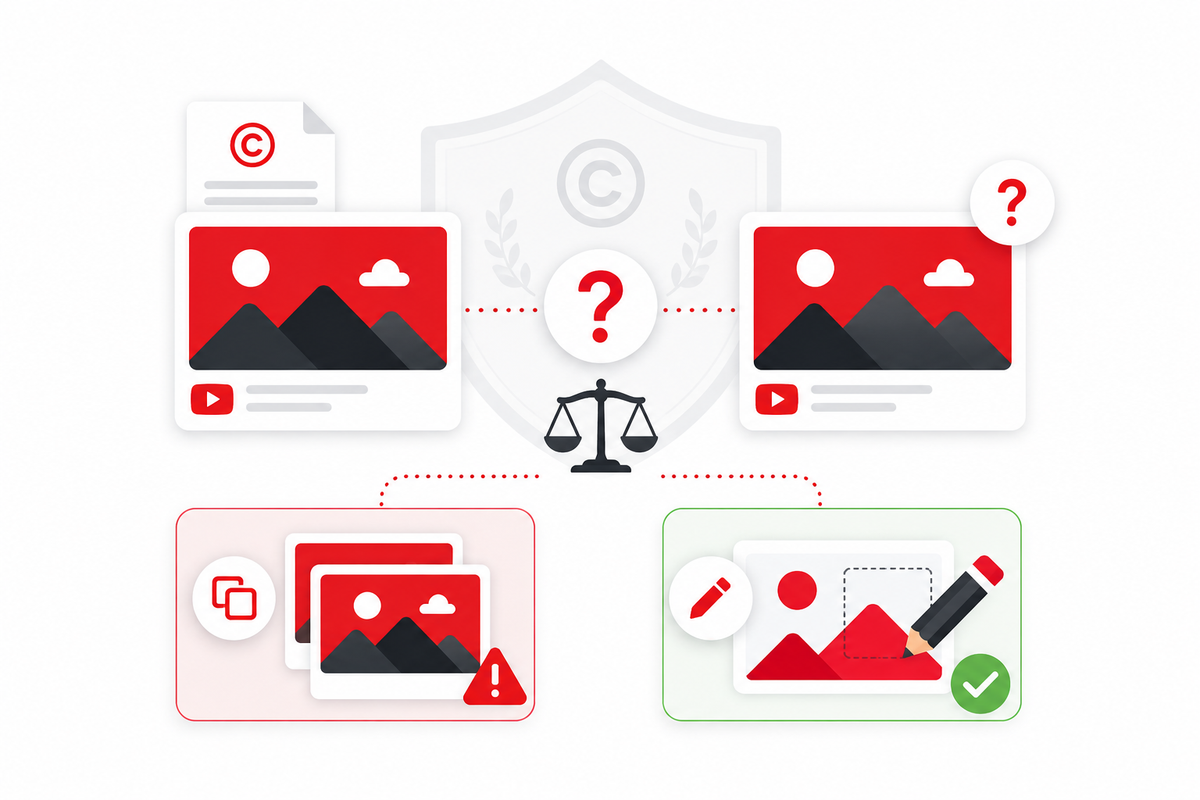
Copyright infringement happens when someone exercises one of the copyright owner's exclusive rights -- reproducing the work, distributing it, or creating a derivative of it -- without permission and without a legal exception like fair use applying. For a thumbnail, that generally means: downloading it and re-uploading it as your own thumbnail, embedding it unedited in a video, or publishing it on a blog or social account without a license, permission, or a legitimate fair-use basis.
Infringement doesn't require that you profited from the use, and it doesn't require that you claimed you made the image yourself. Simply reproducing someone else's protected work without a valid legal basis can qualify, regardless of intent.
What Is Fair Use?
Fair use is a legal doctrine, specific to U.S. copyright law (other countries have their own, differently-scoped exceptions, such as "fair dealing" in the UK, Canada, and Australia), that allows limited use of copyrighted material without permission under certain circumstances -- typically for purposes like commentary, criticism, news reporting, teaching, or research.
Fair use is not a fixed rule you can check off a list. U.S. courts apply what's called a four-factor test, weighing all four factors together against the specific facts of the specific use. There is no formula that guarantees an outcome, and no single factor is automatically decisive on its own.
The Four Fair-Use Factors
- Purpose and character of the use -- Is the use commercial or nonprofit/educational? Is it transformative, meaning it adds new meaning, commentary, or context rather than just reproducing the original for the same purpose?
- Nature of the copyrighted work -- Using a highly creative, original work (like a custom illustrated thumbnail) is treated differently than using a more factual or functional image.
- Amount and substantiality of the portion used -- How much of the work was used, and did the use include the "heart" of the work -- the most distinctive or recognizable part?
- Effect on the potential market -- Does the use substitute for the original or harm the copyright owner's ability to profit from or license their work?
Courts weigh these factors together, and outcomes are genuinely fact-specific. Two uses that look similar on the surface can land differently depending on context, purpose, and market impact. This is exactly why blanket rules about fair use are misleading -- and why you should treat any "guaranteed safe" formula with skepticism.
Common Fair-Use Myths, Debunked
A lot of the copyright advice circulating in creator communities is folk wisdom rather than law. None of the following claims are reliably true:
- "If I change 20% of the image, it's automatically fair use." There is no percentage threshold in the law. Courts don't measure fair use in percentages.
- "If I give credit to the original creator, it's legal." Attribution is good practice and can reduce ill will, but it does not satisfy fair use or grant permission on its own.
- "If it's for education, it's automatically fair use." Educational purpose helps the first factor, but it doesn't override the other three -- an educational video can still infringe.
- "If I don't monetize the video, it's automatically legal." Non-commercial use is one favorable data point, not a free pass. Courts still weigh market effect and the other factors.
- "Adding a disclaimer makes it fair use." A "no copyright infringement intended" caption has no legal effect. It doesn't change how the four factors apply.
Commentary, Criticism, and Reviews
Using a thumbnail as part of genuine commentary or criticism -- for example, discussing why a thumbnail is misleading, breaking down its design choices, or critiquing a channel's visual strategy -- tends to support the first fair-use factor because the use is transformative: you're saying something new about the image, not just redistributing it for its original purpose.
That doesn't make every commentary video automatically safe. If the commentary is thin and the thumbnail is really just being used as decoration or clickbait for your own video, the transformative argument weakens considerably.
News Reporting
Reporting on a real news event that happens to involve a thumbnail -- say, a controversy over a specific piece of thumbnail artwork -- can be a legitimate fair-use context, particularly when the thumbnail itself is the subject of the story rather than just an illustration for an unrelated one. Context and purpose matter far more than the fact that it's labeled "news."
Education
Teaching purposes are one of the classic fair-use categories, and using a thumbnail to illustrate a lesson on design principles, marketing, or copyright itself can be defensible. But "educational" is not a magic word. A course that reproduces images wholesale, with no analysis or transformation, is on much shakier ground than one that critically examines them.
Reaction Content
Reaction videos sit in a genuinely gray area. Reacting to a video's content is different from reacting to and reusing its thumbnail as your own. If you're discussing why a thumbnail worked or failed, that's closer to commentary. If you're simply lifting the thumbnail because it saves you design work, that's closer to straightforward copying with a thin justification layered on top.
Inspiration Versus Copying
This distinction matters as much as any legal factor. Being inspired by a layout -- bold text at the top, a shocked expression, high-contrast colors -- is generally treated very differently from copying. Layouts, color schemes, and general design conventions (arrows, circles, big reaction faces) are not, by themselves, usually protectable; they're closer to an idea or a style, and copyright protects specific creative expression, not general concepts.
Actually lifting someone's specific photo, specific composited graphic, or specific text treatment is a different matter. The safer, and frankly more sustainable, path for any creator is to study what works about a competitor's thumbnail and then build an original image that applies the same principles rather than reusing their actual asset.
Using Screenshots and Thumbnails in Articles
Bloggers and journalists often want to include a thumbnail image when writing about a video or a channel. This is common practice, but it isn't automatically fair use just because it's editorial. The strongest position is typically a small, appropriately sized image used to illustrate genuine discussion or reporting about that specific thumbnail or video -- not a full-size, decoration-only image with no accompanying analysis.
Using Thumbnails on Social Media
Sharing a thumbnail when reposting or linking to someone else's video (for example, a link preview generated automatically by a platform) is different from manually downloading and re-uploading that image as your own post. Automatic link previews are generally treated as a separate, widely accepted convention; manually re-hosting someone's image as standalone content on your own account is not covered by that convention and carries the same fair-use analysis as any other reuse.
Permission and Licensing
The most reliable way to legally use someone else's thumbnail is also the simplest: ask. Many creators will grant permission, especially for legitimate commentary, collaborations, or press coverage, if you contact them directly. Get any permission in writing (an email exchange is enough) so you have a record of what was agreed and for what use.
For stock imagery, some thumbnails are built partly from licensed stock photos. Even with permission from the channel, remember the underlying stock license may restrict certain uses -- so channel permission alone doesn't automatically clear every element of a composited thumbnail.
Creative Commons Thumbnails
Occasionally a creator will explicitly release a thumbnail or its component assets under a Creative Commons license. If so, the specific license terms (CC BY, CC BY-SA, CC BY-NC, and so on) tell you exactly what's allowed -- attribution requirements, whether commercial use is permitted, and whether you can modify the work. Always check the exact license variant rather than assuming "Creative Commons" means unrestricted use; several variants exist with meaningfully different rules.
A Practical Way to Think About Risk
None of the following is legal advice, and none of it guarantees an outcome -- fair use is decided case by case. But it's a useful way to organize your thinking before you reuse someone else's thumbnail.
| Situation | Potential Risk Level | What to Consider |
|---|---|---|
| Viewing or personal reference only | Lower | Not redistributing publicly changes the analysis significantly |
| Genuine commentary or critique | Depends heavily on execution | Is the use transformative, or just decorative? |
| News reporting on the thumbnail itself | Depends on context | Is the thumbnail the subject of the story, or just an illustration? |
| Direct copying with no commentary | Higher | Look into permission or licensing first |
| Commercial use (ads, sponsored content, merchandise) | Potentially higher | Market effect and rights holder impact weigh more heavily |
| Recreating the style, not the actual image | Generally a different, usually lower-risk situation | Build an original file using similar design principles |
What to Do Before Reusing a Thumbnail
- Ask whether you actually need the exact image, or whether an original thumbnail inspired by the same idea would work just as well.
- If you do need the specific image, check whether the creator has stated any reuse terms (video description, channel about page, or a licensing page).
- If nothing is stated, reach out and ask for permission directly -- most creators respond to polite, specific requests.
- If you're using it for commentary, criticism, or news, make sure your own content genuinely analyzes or discusses the thumbnail rather than just displaying it.
- Keep the reproduction reasonably sized and avoid presenting it in a way that could substitute for viewing the original creator's content.
- Document your reasoning (why you believe the use is fair, or where you got permission) in case you're ever asked to justify it.
If Your Own Thumbnail Has Been Copied
If you find another channel has taken your thumbnail, YouTube's copyright takedown process allows you to file a formal copyright complaint through YouTube's copyright tools, which can result in removal of the infringing content. Before filing, it's worth reaching out directly in cases where the use might be a misunderstanding rather than deliberate theft -- it's often faster and preserves the relationship. For repeated or clearly deliberate copying, YouTube's official copyright infringement notification process is the appropriate channel.
Quick Decision Checklist
- Do I have permission, a license, or a Creative Commons grant that clearly covers this use?
- If not, is my use genuinely transformative -- commentary, criticism, or news about the thumbnail itself?
- Am I using only what's necessary, not the full image for no added reason?
- Could this use substitute for the original or harm the creator's ability to benefit from their work?
- Would I be equally comfortable if the situation were reversed and someone used my thumbnail this way?
- If I'm still unsure, would creating an original thumbnail inspired by the same idea solve the problem without the risk?
Frequently Asked Questions
Is a YouTube thumbnail automatically copyrighted?
In most jurisdictions, yes. Original creative works, including custom thumbnail images, are protected by copyright automatically upon creation, without needing registration or a copyright notice.
Can I use a thumbnail if I credit the original creator?
Crediting the creator is good etiquette but does not, by itself, satisfy fair use or grant legal permission to reuse copyrighted material.
Is it legal to use a thumbnail for a reaction video?
It depends on how the thumbnail is used. Genuine commentary or critique about the thumbnail leans toward fair use; simply reusing it as decoration with no analysis is a weaker position.
Can I get a copyright strike for using someone else's thumbnail?
Yes. If a rights holder files a copyright complaint and YouTube determines the use isn't covered by a valid exception, it can result in content removal or a copyright strike on your channel.
Does downloading a thumbnail give me permission to use it?
No. Being able to technically save an image is unrelated to whether you have legal permission to republish it.
Is recreating a thumbnail's style the same as copying it?
Generally no. Layouts, color palettes, and general design conventions are usually treated differently from copying a specific photo or composited graphic. Building an original image inspired by a style is typically a lower-risk approach than reusing the actual file.
Do fair-use rules differ outside the United States?
Yes. Fair use as described here is a U.S. legal doctrine. Other countries apply related but distinct concepts, such as fair dealing, with their own specific requirements.
What's the safest way to use another creator's thumbnail?
Ask for direct permission and get it in writing. Absent that, only use the image for genuinely transformative purposes like commentary, criticism, or news reporting about the thumbnail itself, and keep the use minimal.