Channel management is one of the highest-paying YouTube side hustles, and it starts with a free audit, not a pitch deck. Here is the scope, the pricing, and how to land the first client with data.
Somewhere right now a creator is sitting on a channel that earns money and is stuck: they are great on camera, terrible at operations, and drowning in the parts of YouTube they never signed up for. That creator is your client. Channel management is the service business built on that gap, and it is one of the highest-paying side hustles in the creator economy — full-service management typically runs $1,500 to $5,000 a month, with virtual-assistant-style arrangements around $1,600 and multi-channel agencies at $10,000 or more. The way in is not a pitch deck. It is a free, data-driven audit of a prospect's channel that proves you see what they cannot. This guide covers the scope, the pricing models, how to land the first client, and how the audit wins it.
Introduction
Channel management sounds vague, which is exactly why most freelancers undersell it. In practice it is a defined set of operational services that keep a channel publishing, growing, and earning: strategy, SEO, scheduling, thumbnail direction, community management, and reporting. Creators buy it because their time is worth more on camera than in a spreadsheet, and they keep paying because the results show up in data they can see. The challenge for a new channel manager is not skill — it is landing the first client with no track record. That is solved by the pre-sale audit: diagnose a prospect's channel with real numbers, present the findings, and the contract follows. This guide walks through every step.
What Channel Management Services Cover
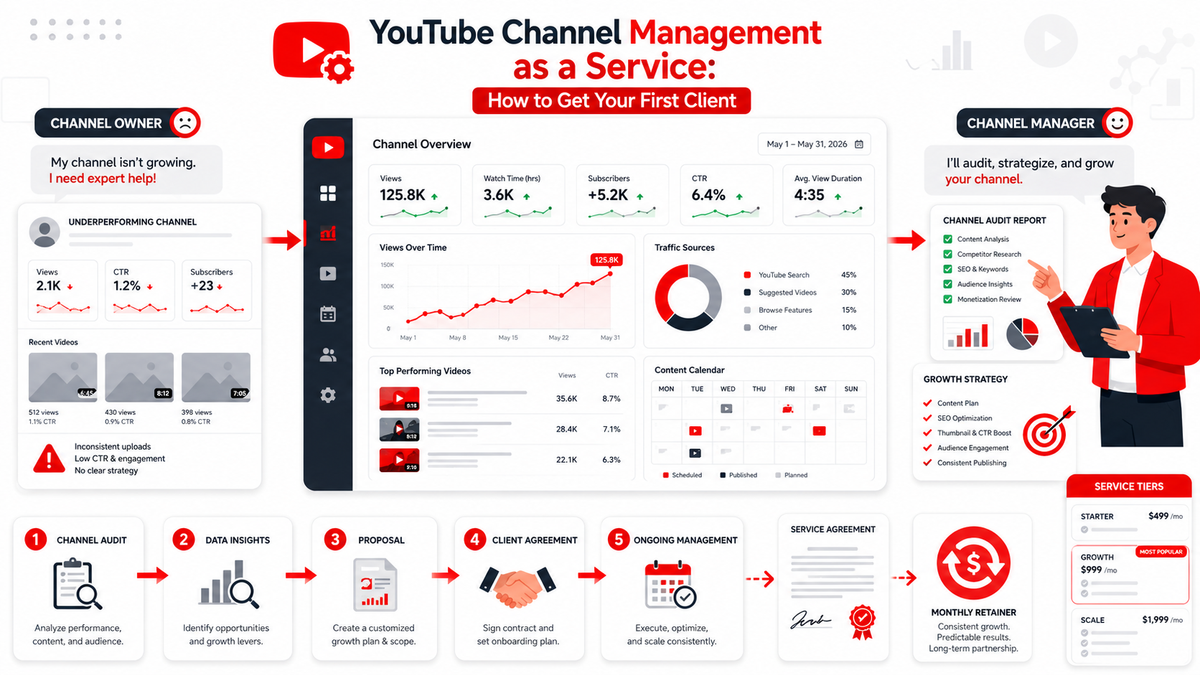
Define the scope clearly before you price anything, because scope is what separates a $1,600 service from a $5,000 one. A full-service package typically includes:
- Strategy: content pillars, video ideas, growth plan, and quarterly goals.
- SEO: titles, descriptions, tags, and keyword research for every upload.
- Scheduling: a consistent upload calendar that fits the algorithm and the creator's life.
- Packaging: thumbnail art direction and hook review — you direct, a designer executes, or you deliver it yourself.
- Community management: pinned comments, reply triage, and engagement strategy.
- Analytics and reporting: a monthly report that connects the work to the numbers.
The lower-priced tier trims the list: scheduling, SEO, and community basics, with reporting kept light. The higher-priced tier adds strategy depth, custom thumbnails, and faster turnaround. Whatever you include, write it down. Scope creep is the silent killer of management retainers. Two scope questions will come up in every first call, and answering them in the proposal saves a month of friction. The first is who owns what: does the creator still film and edit while you handle everything around it, or does your package include sourcing editors and overseeing their work? The second is turnaround: what is the minimum upload window you can support, and what happens when a video is late — does the calendar slip or does the scope flex? Neither answer is right or wrong, but a manager who has thought them through reads as a professional, and a manager who improvises them reads as a project in progress.
Pricing Models and Ranges
The market pricing in 2026 spans three bands. Virtual-assistant-style management — scheduling, uploads, basic SEO, community replies — runs roughly $1,600 a month. Full-service management, adding strategy, thumbnail direction, and reporting, typically sits at $1,500 to $5,000 a month depending on channel size and deliverable volume. Agencies managing multiple channels charge $10,000 a month and up. Channel audits, sold as a standalone one-off, range from $150 to $2,000 plus depending on depth. The standard structure is a monthly retainer, and that is the right structure for you: it is predictable income, and it aligns your incentives with steady growth rather than one-off wins. For your first client, price at the bottom of the full-service band, guarantee a defined deliverable list, and build the case for a higher retainer at renewal with month-one results. A few paid audits at $200 each are also a legitimate way to fill the pipeline while you hunt for a retainer client. The retainer should always be framed around a deliverable, not an outcome you cannot guarantee. Nobody can promise views; everybody can promise a consistent cadence, clean packaging, on-time uploads, and a monthly report. Sell the process you control and let the results speak in the report. This distinction is what separates professional channel management from the guaranteed-growth crowd, and it is also what keeps you legally and reputationally safe when a video underperforms.
Landing Your First Client
The first client is a funnel problem, not a skill problem. The prospects are specific: channels with 5,000 to 100,000 subscribers that clearly publish inconsistently, have generic titles, reply to no comments, and run thumbnails that look creator-made. You can find them the old-fashioned way — watching, searching by niche, and browsing community tabs — and the tell is always the same: good content, inconsistent operations. Your approach to each prospect is a three-line message, not an essay: name the channel, name the two operational gaps you see, and offer a free 15-minute channel audit with no obligation. No attachments, no hype, no 'I can get you to a million.' The offer is the audit, and the audit is the hook. Expect to message dozens; expect a small percentage to respond; expect a fraction of those to buy. That is the normal funnel, and it works because the free audit does real work instead of making promises. The niche you target matters more than the size of the channel. Local businesses, educators, and service-based creators have real budgets and need operational help precisely because they are not creator-native; gaming and entertainment channels are saturated with young, broke, DIY-minded creators. A YouTube manager who targets the accountant with a 20,000-view educational channel and a scheduling mess will close faster and command better rates than one chasing a mid-size gaming creator with no budget. Fit the client to the service, not the service to the hype.
The Pre-Sale Channel Audit
The audit is where you win or lose the first client, and it should be data, not opinion. A strong 20-minute audit covers five things:
- Upload frequency: how often they actually publish versus what their niche rewards. Irregularity is the most common growth killer.
- Views per subscriber: a healthy channel converts a consistent share of its audience into views; a declining ratio signals retention or packaging problems.
- Milestone trajectory: where they stand on subscriber, watch-hour, and Shorts-view milestones, and how fast the numbers are moving.
- Packaging: a fast read of their thumbnails and titles against the niche benchmark.
- One or two quick wins: specific, immediate fixes they can feel confident about.
Present it as a one-page summary with the numbers pulled from their public channel data, and you have done more for them in twenty minutes than their previous 'strategist' did in a month. The audit converts because it proves the thing you are selling: you can see their channel clearly, and you can tell them what to do next. Present the audit as a conversation, not a document dump. Walk the prospect through the three or four numbers that matter, pause after each one to let it land, and end with the quick wins so the call finishes on momentum rather than critique. The audit's purpose is not to humble the creator — it is to show you share a goal. The classic closer: 'I found three things I would fix in the first week. Want me to fix them?' Most prospects who have sat through a real audit say yes.
Using Calculators to Prove Value
The audit goes faster and harder when the arithmetic is automated and consistent. The Thumbix Upload Frequency Calculator quantifies the irregularity you can see by eye — it turns their upload history into a frequency score and a recommended cadence for their niche. The Views Per Subscriber Calculator computes the ratio from their public subscriber and view counts and flags whether it is healthy or shrinking. The Subscriber Milestone Calculator shows the gap to their next meaningful subscriber milestone and what the current growth rate implies for when they hit it. Use these three as your audit toolkit on every prospect. They produce the exact numbers that make a diagnosis feel inevitable rather than anecdotal, and they keep your analysis consistent across dozens of prospects — which is exactly what lets you do a pre-sale audit in twenty minutes and scale the funnel without scaling the hours. The calculators do a second job beyond the audit: they set the baseline you report against. Run the prospect's upload frequency, views per subscriber, and milestone trajectory at the audit, then rerun them at the end of month one and put both numbers in the report. A before-and-after on the same metric is the clearest possible proof of value, and it protects you when growth is slow — if the trendline is moving in the right direction, the renewal conversation writes itself. Data you measured twice is worth more than data you claim once.
Delivering in Month One
The audit wins the client; month one keeps them. Set expectations with a written plan in the first week: the cadence you will publish at, the SEO process for every upload, the packaging changes, and what the monthly report will show. Then execute relentlessly on the basics — consistent uploads, clean titles, improved thumbnails, replied comments — and report the numbers honestly at the end of the month. The retention math is simple: if the channel's metrics improve in month one and the creator can see it, the retainer renews. If you overpromised in the pitch and the data does not move, you have learned the difference between a service and a promise. Manage expectations low and deliver high, and your first client becomes your first case study, which becomes your next three clients. The month-one report is the deliverable that decides renewal, and it should be as simple as the audit. One page with four blocks: what was published and when, what the metrics did (views, subscribers, watch time), what the packaging changes were, and what is planned for month two. Attach the screenshots, not just the numbers. A creator who can see the work and the result in one page trusts the process; a creator who has to dig through a spreadsheet stops reading. The report is also your case study raw material — anonymized or with permission, it becomes the proof that sells the next client.
Final Takeaway
Channel management is the highest-priced YouTube service a single freelancer can sell, and the entry path is a free audit, not a pitch deck. Define the scope, price the retainer honestly, find channels with good content and bad operations, and let the Thumbix Upload Frequency, Views Per Subscriber, and Subscriber Milestone calculators turn each prospect's public data into a diagnosis they can see. Win month one with consistent delivery, and the first client becomes the case study that lands the next three. Data wins the audit; delivery wins the retainer.
Frequently Asked Questions
How much does a YouTube channel manager charge?
Virtual-assistant-style management runs roughly $1,600 a month, full-service management typically $1,500 to $5,000 a month, and multi-channel agencies $10,000 or more a month.
What does a channel manager actually do?
Strategy, SEO, scheduling, thumbnail direction, community management, and monthly reporting — a defined scope that can be trimmed for lower tiers or expanded for full-service retainers.
How do I get my first channel management client?
Offer a free 15-minute audit to channels with good content and inconsistent operations. The audit does the selling; the pitch just opens the door.
What should a pre-sale channel audit cover?
Upload frequency, views per subscriber, milestone trajectory, packaging quality, and two or three specific quick wins the creator can act on immediately.
Do I need my own successful channel to manage others?
No. You need operational skill and data fluency. Your own small channel is portfolio proof, not a hiring requirement.
How should I price my first retainer?
Start at the bottom of the full-service band with a defined deliverable list, deliver visible month-one results, and raise the retainer at renewal.
What tools help me audit a prospect's channel?
The Thumbix Upload Frequency Calculator, Views Per Subscriber Calculator, and Subscriber Milestone Calculator turn public data into a consistent, defensible diagnosis.
How do I avoid scope creep on a management retainer?
Write the deliverable list into the agreement, price additional work separately, and review the scope at every renewal.